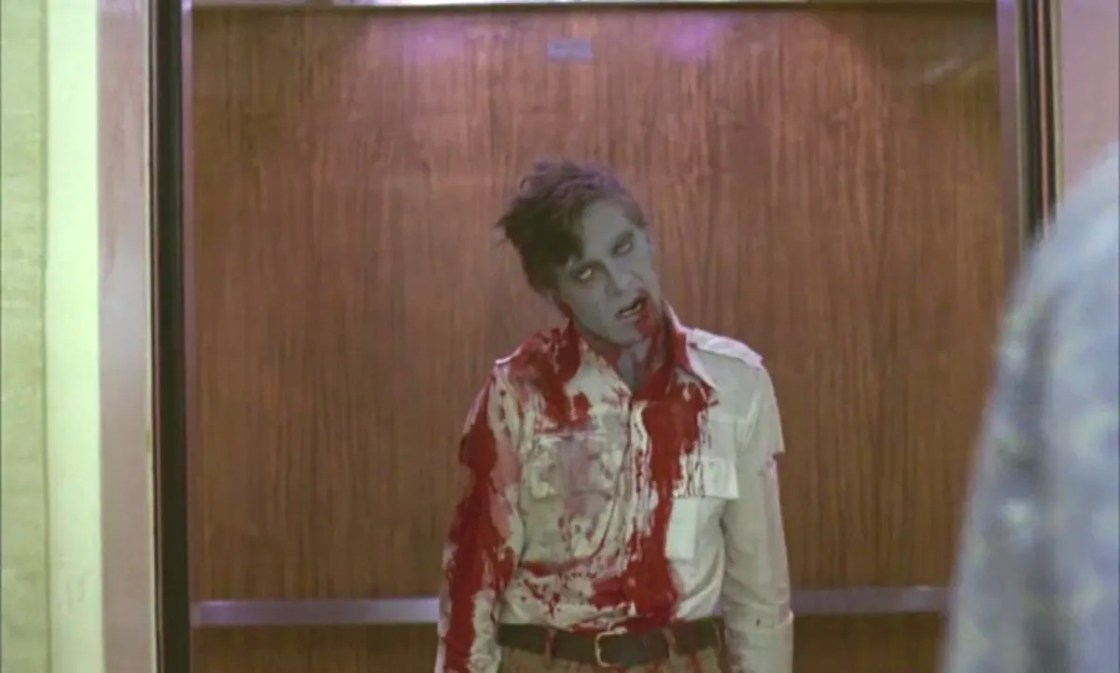
Dawn of the Dead is one hell of a jump from Night of the Living Dead.
Which is the reason that it’s the second Romero movie to feature in this retrospective, but hey, can you blame us? It helped create and define a new and much darker version of the zombie genre, taking the ideas that Night was bursting with and streamlining them to perfection. The fact that it is not my favourite zombie movie (that’s still Night) means, frankly, there is something wrong with me.
Despite all of the horrific violence and psychological turmoil, I just had a big smile on my face throughout the two-hour runtime of George A. Romero’s 1978 sequel to Night of the Living Dead . Dawn of the Dead is one of those movies (of which Aliens and Mad Max Fury Road are other examples) where you can sit back, relax and trust that you are in good hands with the director. It is an absolute marvel of construction and execution; the way Romero can weave different themes, even those that only matter for a single sequence, makes every moment of this movie feel huge.
Not a surprise, really, when you consider the movies he made between his two zombie flicks, Barring the romantic comedy (no, really) he made called There’s Always Vanilla (one for the completists, I’m sure), Romero put horror and metaphor to good use in the feminist (for its time) Season of the Witch, his shelved-until-2021 horror of the mind, The Amusement Park, and the nastiest vampire coming of age movie of all time, Martin. Not to mention his brilliant dress rehearsal for another zombie movie in The Crazies (the remake of which is a guilty pleasure, mainly because of Timothy Olyphant), All of these movies observe and investigate the psyches of their characters in ways that are sometimes invisible, but never pretentious. Taking these movies together, it becomes clearer that Romero had broadened and sharpened his skills and refined his subjects as a filmmaker by the time he turned his attention to Dawn. It may sound weird calling Dawn of the Dead a refined movie, but its refinement is masked by his prowess for absolute chaos.
Unlike Night, Dawn is a lot more character-based, mainly because Romero had given us more than a night to get to know, Peter, Steve, Francine, and Roger, Seeing and participating in some awful things, and with no idea what or why this is happening, the four get on a helicopter and get the hell out of there. We are introduced to the chaos through these characters: Francine works at a TV station, and is surrounded by the normal reliable sources of information, all of whom are doing little more than shrugging their shoulders – the impotence of the industry underlined when she has to deactivate some channels to conserve power. Peter and Roger are SWAT officers who are clearing out a low-income housing project that mostly houses Black and Latino residents who are refusing to give up their dead. Romero could have just had an action scene full of zombies, leaving the people out of it, but he does it this way to show the dwindling sense of humanity that is shown as much her physically, as it is mentally at the TV station. Romero further highlights this with the Johnstown (no, Johns) sequence, which could be set right after Night of the Living Dead. It is a game to them for now.
Dawn is about survival (I know, obviously) but Romero puts his characters in the relative height of comfort first. We have all thought it askids: how cool would it be if we had free-run in a shopping centre (alas, the only thing more effective at catching you than a zombie horde,is the mother of a small child)? In a metaphor that must have had JG Ballard calling his lawyers, Romero makes the mall feel like heaven. You get to wear snazzy suits (Peter’s blue pinstripe number was very nice), but having everything can quickly feel like you have nothing. Francine, who smokes throughout her pregnancy (was that symbolic or did they not know?) wonders what they have become, bringing to mind a conversation they had while wondering why the zombies where there
Francine: What are they doing? Why do they come here?
Stephen: Some kind of instinct. Memory, of what they used to do. This was an important place in their lives.
It doesn’t take long for them to feel the same way. The metaphor for the zombies here is the indolence of consumerism, the way it creates would-be zombies out of convenience; the human characters as mindless as the zombies. Let’s not give the survivors all of the attention though: let’s take a look at Roger and Steve. Roger’s arc in the movie is excellent, perhaps the best in the film – from the moment a rookie who he is trying to calm down has his head blown off, it was strange to me that Roger doesn’t lose it right there. It isn’t until he is doing the truck run with Peter that I realised that Roger’ mistake was that he got to cocky, too comfortable. Yeehawing all over the place got him killed because everything felt too easy.
The there is Steve, my beloved Flyboy. The thing about Steve is that his confidence always seems to be on a sliding scale; despite being the only one who can fly the helicopter until deep in the movie, Steve feels emasculated compared to Peter and Roger when it comes to shooting and killing zombies. He is also, and obviously. in love with Francine. Romero cleverly releases these details gradually to his characters,, but the actors, especially David Emge as Steve, do a great job of keeping their feelings close to the surface without melodrama. Steve’s death may be the most iconic for a featured character in the series – his pride and sense of ownership override his reason and obliterate his and Peter’s plan to deal with the bikers. He can’t have Francine, and I applaud Romero’s decision in not inventing any kind of love triangle. Steve might be the best symbol of Romero’s themes in Dawn, as he whispers to himself that the mall is theirs that they found it and he won’t let it go.
While Night of the Living Dead is the best zombie movie ever made, Dawn of the Dead is the most important. Through all of the tremendous blood and guts (genuinely shouted when that guy’s head was blown off) it tells a riveting, yet unshowy psychological story that asks whether human beings can truly live in heaven when Hell is empty and banging on your door.
Catch up on the rest of the season of the dead here, and, if you enjoyed this article and want to see more stuff like it, please consider supporting us on Ko-Fi.
By Kevin Boyle

