Look, maybe you can fuck around in a haunted house during the day, maybe piss about a bit the late afternoon, maybe even push your luck till the early evening – but never after dark.
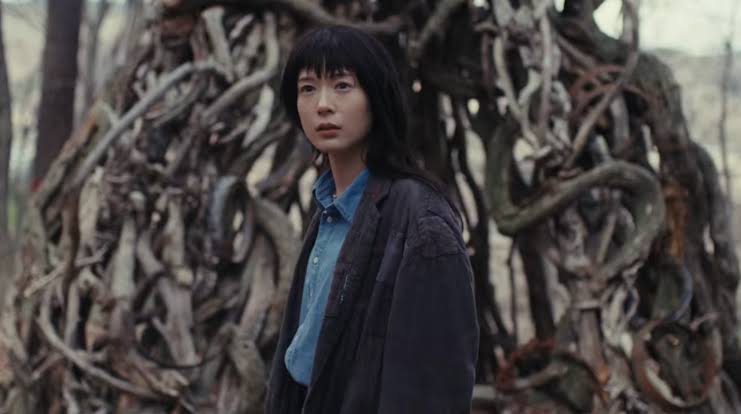
Which brings me, usefully enough, to Never After Dark, a recent release from director Dave Boyle. Never After Dark brings us to a bed and breakfast in rural Japan, owned by a widow, Teiko, who is convinced she has begun seeing visions of a ghost in the building. Her son hires a psychic medium, Airi (Moeka Hoshi), to clear the building of ghostly infractions, only for her to discover while staying there the bizarre history of the place tied to a previous tenant, Inokoshi.
Much of Never After Dark’s strength lies in its restraint – while I can imagine some viewers finding the lack of expanded backstory for both Airi and, to a lesser extent, Inokoshi frustrating, I appreciate the brevity of storytelling here that gives us little more than the bare bones (pun intended) of the characters at hand. But the entire movie, with its woozy, uneasy sense of time and place, kind of resists a more traditional storytelling approach as it is – the way timelines and events overlap with each other, fissures feeding into the past and present, it would feel out-of-place to fit all the pieces together in a more straightforward narrative structure.
What it lacks in direct backstory, it makes up for in brilliantly eerie atmosphere and character work. The rural house the story unfolds at makes for a perfect haunted house, long corridors and side doors and dark corners aplenty, while the property that surrounds it (tiny, unsettling church included) looks like it could have been made with the intention of serving as a horror movie backdrop. Studded with moments of shocking, jolting violence, Never After Dark refuses to let you get comfortable, with distinct, disturbing images scattered throughout its slow, steady runtime.
Airi is a fascinating lead, haunted in the most literal sense of the word, but having turned the struggle that ousted her from normal life into a career that combines the supernatural with the impossibly pragmatic – she’s a procedural lead who just so happens to use the world beyond the veil as her investigative arsenal, and the way she navigates the slow unfolding of the horrors that the house contains are downright fascinating to watch. Though he’s mostly limited to the third act, Bokuzō Masana really runs away with the film as antagonist Inokoshi, an off-kilter turn that never really lets you get your feet underneath you, a properly disturbing turn that never descends into parody.
Never After Dark is a strange but enormously satisfying movie – part procedural, part haunted house movie, part slasher, wrapped up in an eerie and off-centre narrative device. It’s one of the most unique and singular horror films of the year, with confident handling behind the camera from Dave Boyle to bring it all together. If you’ve seen it, I’d love to hear what you made of it in the comments below!
If you enjoyed this article and want to see more stuff like it, please consider supporting us on Ko-Fi. You can check out more of my work on my personal blog, The Cutprice Guignol!
By Lou MacGregor

