Well, it’s time to talk about the Big Basket-Fucking movie.
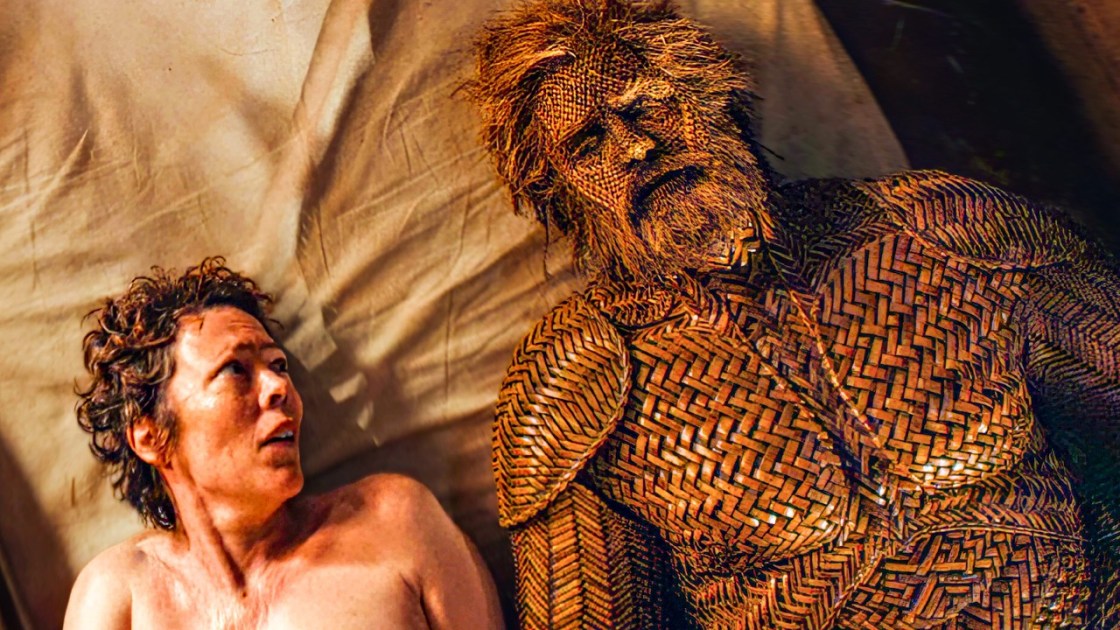
By which, of course, I mean Wicker. Adapted from The Wicker Husband by Ursula Willis and directed by Alex Huston Fischer and Eleanor Wilson, Wicker is one of those films that’s just outrageous enough in its premise to attract a fair amount of buzz before it even hit screens: a Fisherwoman (Olivia Colman) commissions a local basketmaker to weave her a husband made of wicker (Alexander Skarsgard).
Truthfully, when I first heard this premise, I had my doubts – it’s a such a big swing, such a ridiculous idea, that it could easily get swallowed up in its own daftness. Wicker is a lot of things; a comedy, a sex romp, a fantasy. The nebulous setting and vaguely magical tone give it the feel of a fairytale, but one that’s as bawdy and bloody as any classic Grimm’s tale. Fischer and Wilson find a balance that keeps the movie feeling distinctly adult and sharp-elbowed without losing the sense of wonder at its heart.
It all hinges on Colman’s brilliant performance as the Fisherwoman – it almost goes without saying that she’s simply one of the best to ever do it, but this is no exception, a brilliant and weighty performance that masterfully balances the movie’s strange premise and disparate tones. Dinklage’s Basketmaker is at once mundane and magical, as quick to talk cock as he is to magic a man out of wicker, while Alexander Skarsgard as the man himself (fresh off another weird erotic romance in Pillion) is never lost behind the remarkable effects.
Debicki’s Tailor’s Wife, though, is probably my favourite part of this movie, a truly brilliant villain – because, really, she’s just trying to cling to the roles and rules that have governed her life for so long, as a wife, as a mother, as a woman in this society, and the Wicker Wedding challenges that. Debicki’s barely-restrained ire is downright masterful, the frustration and fury as she sees someone else reject what’s been so central to her life with such ease and joy, She’s a monster whose cruelty makes complete sense, a footsoldier for the system that contains her.
But Wicker is, at its heart, a love story. I love romance as a genre, but I so often find it frustrating to see it tacked on to other stories as a last-minute tick-box addition; you know, a crammed-in love interest tossed into an action movie or drama show that’s clearly just there for the sake of it. But Wicker treats its love story with the utmost seriousness, despite its deft, witty tone – the relationship between the Fisherwoman and her husband is deliberately contrasted with the restrictive, carefully-controlled roles applied to the marriages of the other people in the village, one that acknowledges their differences, their abilities, and their skills and makes space for them within their marriage rather than imposing ill-fitting demands based on their sex. And hey, speaking of sex, there’s plenty of it in this movie, which has garnered a lot of attention based on the, you know, big wicker cock. But the film finds a great balance between silliness and sensuality that feels very true to good sex in real life; not entirely serious but impossibly fun.
Wicker is a gorgeously off-beat romance, one which marries its various tones with ease and wit and makes space for some tremendous performances, particularly from Colman and Debicki. It soars past its outlandish premise- and takes what could have gone down as just a gimmicky basket-fucker movie into downright excellence.
If you enjoyed this article and want to see more stuff like it, please consider supporting us on Ko-Fi. You can check out more of my work on my personal blog, The Cutprice Guignol!
By Lou MacGregor
(header image via YouTube)

