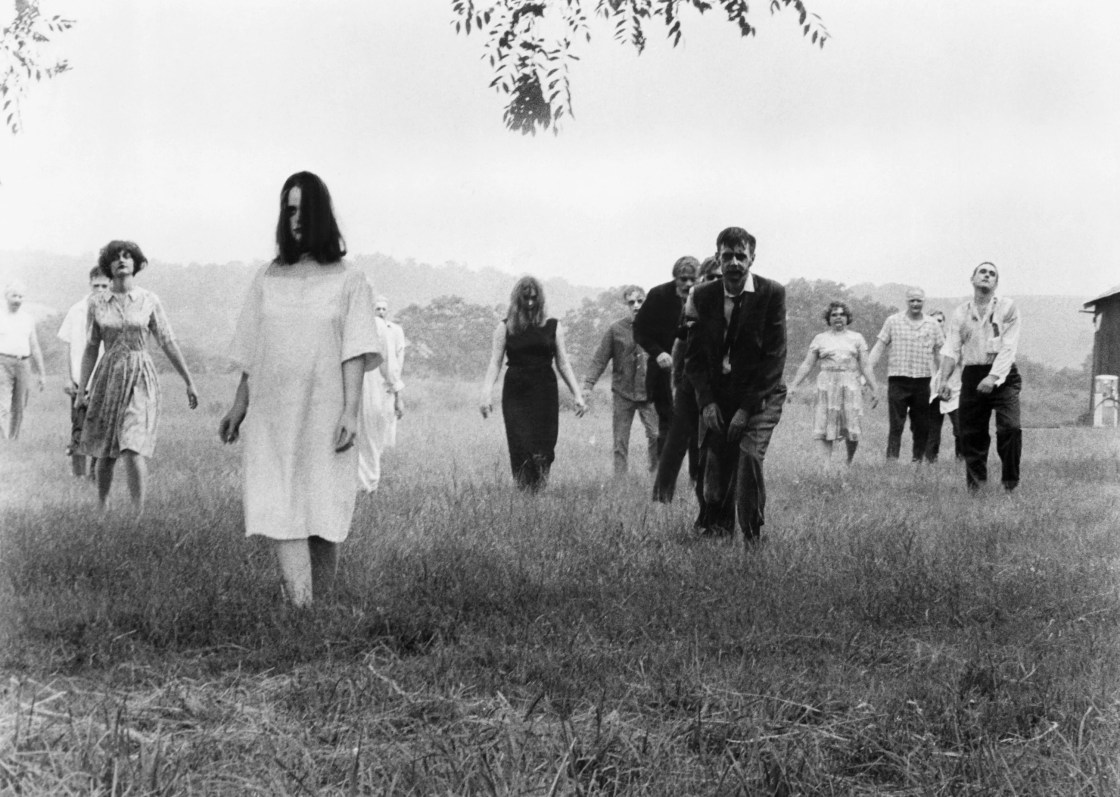
Looking through the classic monsters of cinema. it is amazing to see how few of them have changed beyond recognition. That is not to say the likes of vampires, ghosts, demons, and werewolves aren’t rife with metaphorical possibility that’s bent to fit various eras of film, but their core characteristics are largely the same from their earliest onscreen appearance to now. Thanks to the sheer amount of zombie media in the 21st century, you would be forgiven for thinking that this was true of the shambling undead. Except we know from the previous three articles of this series that the cultural place of a zombie was not always the typical hungry hordes taking over the world. That is, until George A Romero’s Night of the Living Dead.
In the zombie sub-genre of horror, all roads lead to George A. Romero. Night of the Living Dead is a reaction to what came before and every zombie movie after is a reaction to it. Night doesn’t share much in common with White Zombie or I Walked With a Zombie – it has nothing to do with Vodou, there is no melodrama or romance of any kind, mainly because no one has any time for it. And, while the dead do rise again, and in a graveyard, the only thing it shares with Plan 9 From Outer Space is that it is an indie horror movie created by a singular artist (except, unlike Wood, Romero is actually good). Night of the Living Dead is a daunting movie to write about due to its deserved status as the birth place of modern zombies. To chart its cultural identity, it’s best to compare it with the very movies it’s replacing – and look at how these changes would chart the beginning of the second age of the zombie.
Fittingly. the dead in Night of the Living Dead have no clear-cut origin. There are no vodou priests, no women being turned into facsimiles of themselves, and no jealous lover or pissed-off mothers behind it all. While there is the smallest hint that something falling out of the sky is the cause of the titular Night, it remains little more than a gesture in the direction of an answer and is never more concrete than that. From the introduction of cannibalism (which may be Romero’s greatest design feature) to the lack of controlling force, Romero’s zombies are a force of nature that cannot be negotiated with. Only by mirroring their destruction is there any chance of beating them.
While we begin with Barbara and Johnny taking part in the least solemn visit of a loved ones grave, the dead don’t so much rise as shamble over. It’s a great opening, because Romero lets the inherent spookiness of the scene play out as a tattered man hobbles towards the siblings as Johnny jokes that the dead are coming to get Barbara. I love openings like this, for one because it’s cheeky, but also because Romero is playing with our – and Barbara’s – expectations. As far as she knows, Johnny is just being a dick, but we know that Barbara and Johnny are in a movie called Night of the Living Dead, and we know that some ghoulish brotherly clowning is not just taking place, but something even worse than either of them could imagine.
There are no dashing heroes here. Ben is the closest, but is battled every step of the way by Mr Cooper. Night of the Living Dead is about a group who cannot trust each other long enough to survive. Cooper thinks he should be the hero of this story, John Wayne-esque, but not only does he fail to save himself and his family, he becomes the human villain of the story, As for Ben – well, up until Night of the Living Dead people who looked like Ben were on the poster of the zombie movie as a symbol of lost humanity. Ben had no chance, in the world of the movie or out of it,
Normality is the enemy in Night of the Living Dead. Instead of the island of San Sebastien, or whatever parallel dimension Plan 9 takes place in, there is no wild or cinematic setting that allows us distance from what is going on. Barbara, along with Duane, the Cooper family, and assorted zombie dinner, are stuck in a rundown country house that becomes smaller and smaller as the hordes of the dead grow larger. Night of the Living Dead has more in common with survival science fiction horror like The Thing From Another World or Invasion of the Bodysnatchers than anything with a zombie in it. In establishing a whole new set of tropes for the subgenre, it moved away from what we knew before and into a whole new version of the risen dead.
Night of the Living Dead is an almost-mythical part of the zombie movie canon, and the beginning of zombie movies as we know them now – but it was only the start of Romero’s legendary dalliance with the zombie genre, and we’ll be getting into that more in our next article on Dawn of the Dead. Catch up on the rest of the season of the dead here, and, if you enjoyed this article and want to see more stuff like it, please consider supporting us on Ko-Fi.
By Kevin Boyle

