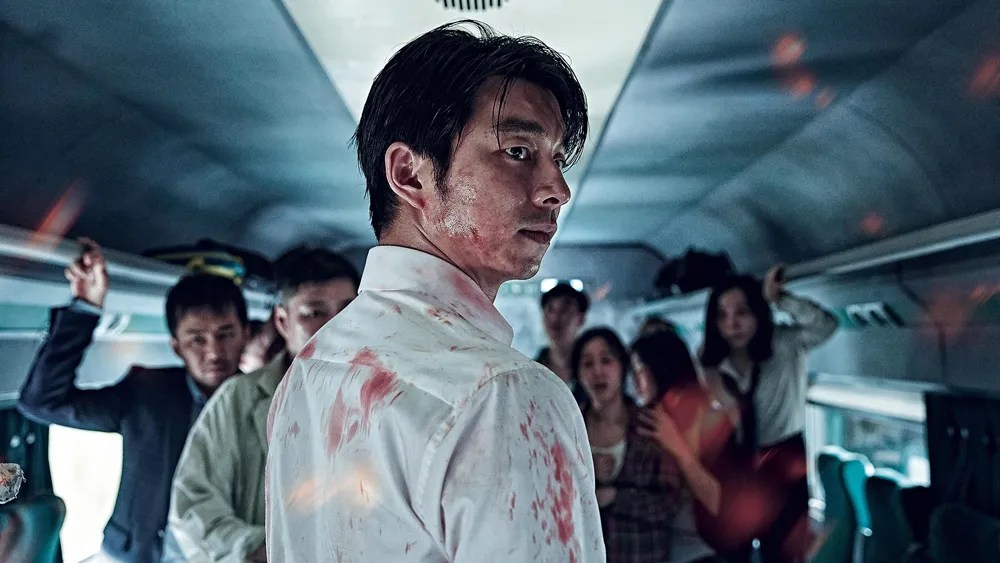
Punch your tickets, friends, fiends, and foes – it’s time to get on the Train to Busan.
2016’s Train to Busan is, for my money, one of the best zombie movies ever made. Which I know is a big statement, given what we’ve already covered so far – from the classic genre-definers to the cult classics to to modern mastery – but this movie? This is the one for me. Directed by Yeon Sang-ho, the film’s premise is pretty simple: Seok-woo (Gong Yoo), a divorced father, travels with his daughter from Seoul to Busan. Except outside the train, there’s a zombie apocalypse breaking loose, and it’s up to the makeshift community of passengers aboard the train to survive it.
Pulling in nearly $100 million at the box office on a less than $10 million budget, Train is the rare bonafide box office smash that matches its financial success with its sheer quality. I’m not blowing anyone’s mind when I say that Train to Busan is utterly fantastic, but take this as your sign, if you haven’t seen it yet, to get it on that damn watchlist.
Train to Busan is one of those movies that’s a true symphony of cinematic brilliance. It’s not only a brilliant zombie movie, but one of the best action films I’ve ever seen – one of the very few films that truly earns the moniker of non-stop (and I’m not just talking about the train journey) – from the first snatched glimpse we get of the undead on the train platform to set-pieces that comfortably top one another to the nail-gnawing climax, you punch that ticket and get swept along whether you like it or not, Of course, it helps that its blessed with one of the strongest dramatic ensembles I’ve ever had the pleasure of watching, which really makes that action and horror feel like it means something; no matter the technical chops, it’s hard to care if you don’t give a damn what happens to these characters, and Sang-ho juggles the hefty ensemble with ease. The consistent claustrophobia of the train, the limited space and the fast-building stakes (not dissimilar to REC) fill out the near two-hour runtime comfortably, from that exhilarating opening on the platform to the emotional climax on the tracks.
But what gives this film its punch – and what sits it comfortably amongst the classic zombie movies of decades past – is how it uses the outbreak as a metaphor for the class divide and societal unease that would go on to become such a huge part of South Korean cinema that broke out into the global mainstream. The movie opens with a striking image – a farmer is pulled over a checkpoint, and realises he has been lied to about the reason for the check, leading to him hitting a deer which then reanimates, The outbreak itself is not supernatural in nature, but a blunt result of corporate greed, interference, and corner-cutting, as represented through the rest of the film by the rich passengers in first class who are willing to throw their less-fortunate companions under the bus when push comes to shove. The zombies are less the metaphor here than the passengers on the train are, becoming a microcosm of South Korean society and the willingness of the wealthy elite to sacrifice the working class. As Jack Buchanan put it in his essay on the movie, “much like the separate carriages in the train, when someone shuts the door in your face there’s little chance of becoming anything other than one more drone in the horde of ignored working class people behind you”.
And that brings us to a close for the Season of the Dead! If you’d like to read more about our favourite zombie movies of the 2020s, check out our coverage of 28 Years Later and The Bone Temple – and, if you’d like to take a dive into the series from the start, you can do so here. Thanks for joining us on this shamble through the undead, and we hope you’ll stick around for the rest of the year to enjoy everything we have to share at No But Listen!
If you enjoyed this article and want to see more stuff like it, please consider supporting us on Ko-Fi. You can check out more of my work on my personal blog, The Cutprice Guignol!
By Lou MacGregor
(header image via Variety)

