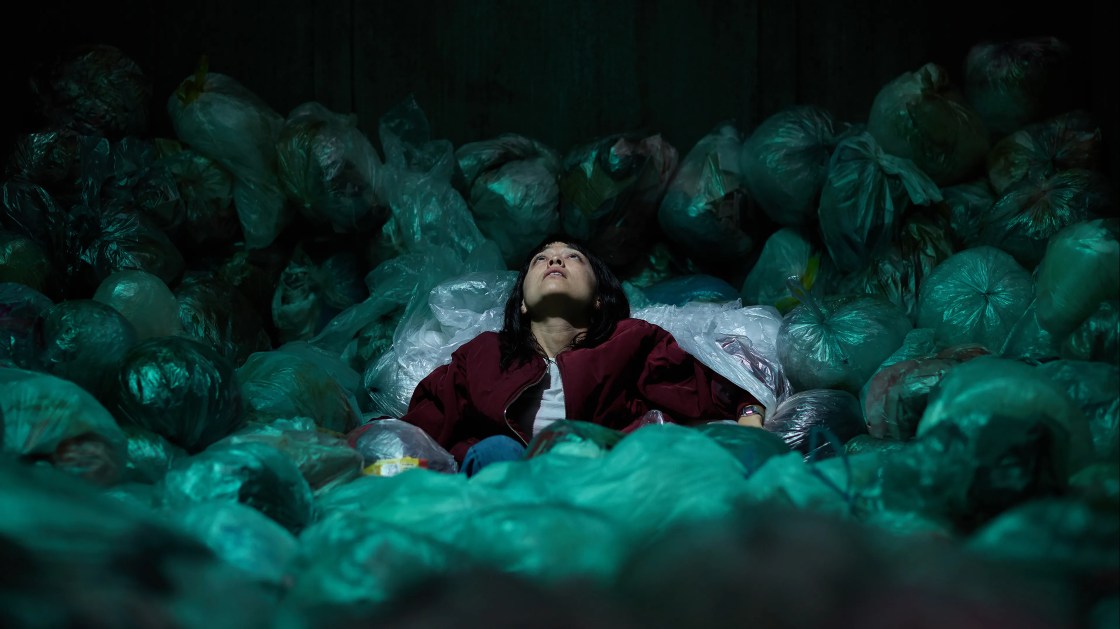
Saccharine is not just a movie about weight loss – it’s a movie about what that weight loss represents. Well, that, and ghosts. Ghosts, too.
Directed by Natalie Erika James (and yes, this is your sign to see Relic if you haven’t already), Saccharine follows Hana (Midori Francis), a medical student struggling with eating problems and body image issues who desperately longs to lose weight. When she discovers a strange new fad involving consuming human ashes in order to drop the pounds, she begins taking pieces of a cadaver donated to her university to take as pills. While the plan works and she soon slims down, she becomes haunted by the ghost of the woman whose body she is consuming, and must contend with the strange appetites her new diet has left her with.
While Saccharine is, broadly, a movie that deals with the horror of body obsession – how it stretches out to infect every detail of our lives, from the food we eat to the movement we do to the people we allow ourselves to associate ourselves with and what we feel worthy of – it’s more specifically a film about where those things overlap with the female experience. Specifically, here, the queer female experience, and it’s an overlap that makes a lot of sense.
Being a woman attracted to women is to contend with the uncomfortable overlap between desire and envy, especially when it comes to the toxic game of comparison that so often plays out in inter-female relationships – when Hana is first approached by an old friend about the ash pills that have led to her weight loss, it’s initially framed as some kind of flirtation. Hana’s original impetus in the movie to join a twelve-week program to change her body composition is, at least in part, due to this exact mix aimed at the woman running it, Alanya (Madeleine Madden). Their first moments of physical intimacy come during Hana’s workouts, a hand on the back to correct posture, voice in the ear to encourage her to keep pushing – Hana doesn’t just desire her body sexually, but she desires it for herself, too. To make herself worthy of being the kind of woman she believes Alanya wants, she denies herself food, rest, weight, the indulgence of her desire only granted when she reaches a certain level of reticence everywhere else in her life. When they eventually have sex for the first time, Hana binges on food in Alanya’s kitchen in her sleep, barriers down, unable to deny herself any longer. The movie closes on a dreamlike sequence of Alanya, laid out in a nearly saint-like arrangement, having been cut open and partially eaten by Hana, her desire finally crashing in to a need to a consume where nothing else satisfies.
But the other woman that Hana has a significant relationship with over the course of the film is Grace, the corpse of the woman who she uses to make the pills that lead to her weight loss. In an entirely different way, Hana consumes her on an intimate level, literally taking her body into hers – one of the first real scare sequences shows Bertha’s form melding with a helpless Hana as she lies in bed. Grace, to Hana, represents a worst-case-scenario of letting her binge eating go unchecked – a woman denied so much as her own name (nicknamed “Big Bertha” by the other medical students) because her size always came first, who, even as a ghost, primarily appears in cutlery and kitchen items as though they were the only places she truly felt seen. The film does a compassionate job exploring Grace’s eating disorder in life, and in death, Hana faces this tension wherein she needs to consume Grace to avoid becoming like her.
I love the way Saccharine explores these ideas, the rich territory of consumption, lust, and denial that can complicate desire between women – it’s a really rich movie in that regard, despite some scrappiness in the script, and a timely one given the state of women’s body image in the media right now. I’d love to hear your take on it, so please let me know your interpretations (and general thoughts) in the comments below!
If you enjoyed this article and want to see more stuff like it, please consider supporting us on Ko-Fi. You can check out more of my work on my personal blog, The Cutprice Guignol!
By Lou MacGregor
(header image via Indiewire)


Lou, this analysis is stunning. 📽️ The way you’ve unpacked how Saccharine explores the overlap between desire, envy, and self-denial in queer female relationships and how that becomes literal consumption is so rich. Grace’s ghost as worst-case scenario, Alanya as desire made tangible. This film sounds like it’s asking all the right devastating questions. Brilliantly written. 💔
Love & HugsKhadija 💕🤗
LikeLike