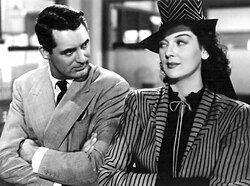
Certain films are more than just films: they are gateways into a whole new filmic language. For me, David Lynch’s Lost Highway was a gateway into arthouse, film noir, and the path to Twin Peaks; Let the Right One in was a gateway to the different outlooks and traditions of foreign horror. There is one film that was not only a gateway to a genre for yours truly, it was (to mix these metaphors) the key that unlocked an entire era of film history. That film is Howard Hawks’ 1940 comic masterpiece, His Girl Friday.
The great films that have endured from Hollywood the 1920s to the beginning of the 1960s feel like broadcasts from a very mannered different planet, and His Girl Friday is no exception. The camera work is traditional and often static in comparison to what we can do now which means that the real strength of the film is the script – so sharp I get a paper cut just thinking about it – and the performances.
I thought, because of the Hayes Code, that old comedies were toothless and a bit embarrassing. Much to my shock both Cary Grant’s newspaper editor, Walter Burns, and his ex-wife and ex-top reporter, Rosalind Russell as Hildy Johnson, are so morally reprehensible that they would fit right at home with the gang at Paddy’s pub, or form the print news division in Network. Hilariously, there is even an opening title card that warns us that we are about to see the two biggest snakes in the whole pit battle and fall in love all over again. You think Tom Hanks was a bit of a dick in You’ve Got Mail? Well, these two barely bat an eye when a distraught woman throws herself out of a window, and that’s the least of it. His Girl Friday did a lot to smash my expectations of this period, and really opened my eyes to just how brilliant and sharp-elbowed movies of this period could be.
The word that always comes to mind when I think about His Girl Friday is rhythm. Each scene is a set-piece of blocking and dialogue more exhilarating that most blockbuster action scenes today. At the heart of it is Grant as Burns. Though he only appears in half the film, his presence is felt every minute. His scheme is to trash Hildy’s plans for marriage and a normal life with insurance man Bruce Baldwin (an underrated saint played by Ralph Bellamy) by hooking her back into the job that she loves. And, though it may be his plan, it is Russell’s film. Hildy is character decades ahead of her time, bossing every room she’s in by virtue of being just as cutthroat as her peers, willing to go as low as Burns in pursuit of her story and just as quick on the draw with a cutting quip.
Without His Girl Friday I would never have thrown myself into classic Hollywood cinema. No Hitchcock, no Huston, no Stewart, no Hepburn(s). For that, I will always love it beyond just the exceptional sum of its parts, even if it gave me a questionable interest in lady journalists with a moderately terrible moral code.
What movies unlocked a whole genre for you? Let us know in the comments below! If you enjoyed this article and want to see more stuff like it, please consider supporting us on Ko-Fi.
By Kevin Boyle
(header image via Wikipedia)


One Comment