Now, as someone who has been through their own mental health crises and issues, I’ll admit that I’m a bit sensitive to the portrayl of this subject on the big and small screens. (and yes, I have still not gotten over my falling out with Ari Aster over the crummy and almost throwaway use of bipolar disorder in Midsommar). So, you would think that The Last Viking’s blunt and often comical use of trauma, mental health, and repression would put my proverbial lunatic back up – but, instead, it’s completely the opposite.
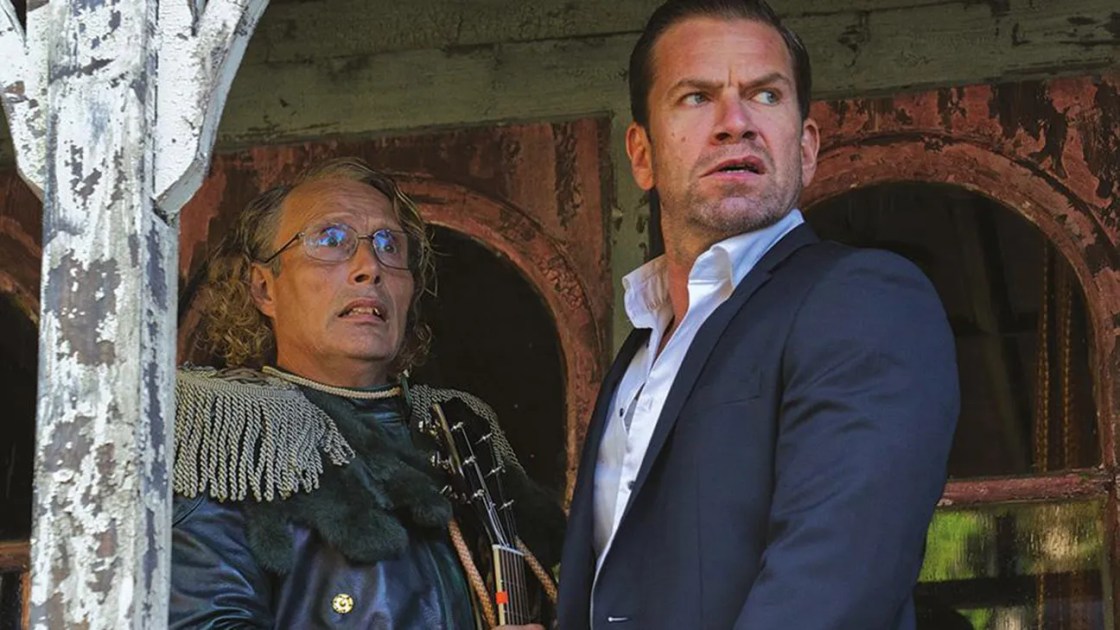
The Last Viking stars Nikolaj Lie Kaas and all-time favourite Mads Mikkelsen as brothers Anker and Manfred, looking for buried heist money near their old family home. Sounds like a simple, almost Coen Brothers-esque set-up, but there are a whole heap of complications – Anker is just out of prison, with his heist partner Friendly Fleming (friendly because he will offer to fix your door while also threatening your life with the tools he’s using to do it) pressuring him to get the remaining money to pay off his own debts. The problem with that is that Manfred is the only person who knows where it is buried but he has severe (as if there is any other kind) dissociative identity disorder, and thinks that he is John Lennon. Add the fact that their old family home, a place haunted by the memory of their father’s abuse of them, is currently occupied by the most passive-aggressive couple in all of cinema. Yes, even worse than in Who’s Afraid of Virginia Woolf.
narrative.
I loved this film. I loved its bluntness and wit, how it still dealt with the subject matter with as much respect as it did farce, using one to draw out the other in a perfect balance of the melancholic and madcap. The film’s director, Anders Thomas Jensen, is becoming quite the expert with this type of balancing act; his last film, Riders of Justice, set itself up as a Death Wish-style revenge story, but used that concept to explore the concept of different types of manhood and how we grieve and handle emotion differently from each other. That is exactly what The Last Viking does; uses comedy to Trojan-horse issues like abuse, repression, and violence to mirror the same way these issues often break through into the real lives of those living with them.
So much of the film hinges on the notion that people cannot be narrowed down to a single version of themselves – explicitly, in terms of Manfred’s DID, and more subtly, in the various experiences the brothers’ family had with his abusive father. Even the choice of John Lennon as the central focus of Manfred’s identity split feels deliberate, given his own history of domestic violence contrasted with his famous songs about peace, love, and unity.
And it taps into the central relationship between brothers to explore the different effects of how trauma takes root to create different outcomes – Anker is outwardly angry and abusive, but actually repressing much of the pain he suffered as a child, whereas Manfred is more reserved while having, in some ways, a clearer grasp of his own abuse – is downright brilliant, and the excellent performances from Mikklesen and Le Kaas imbue them with the weight of what they themselves have yet to come to terms with. By the time the movie ends, these characters, who at first seemed so disparate, make perfect sense.
The film’s entire ethos is right there in its first scene with Manfred, as he looks through a jigsaw puzzle and taking out the bits that he thinks doesn’t fit. At a glance, it looks impossibly messy and to shattered to bring together, but Anders Thomas Jensen finds a way to put the puzzle together with enormous wit, clarity, and care.
If you enjoyed this article and want to see more stuff like it, please consider supporting us on Ko-Fi.
By Kevin Boyle
Featured Image: The Hollywood Reporter

