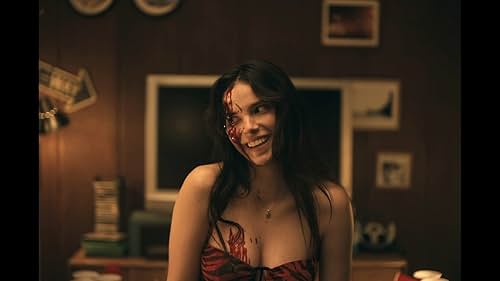
Obsession, on its surface, might seem like a gleefully nasty romp through passion taken to poisonous extremes – but in between the Wishing Willows and gag-worthy gore lurks one of horror’s most incisive depictions of coercive control and abusive relationships.
After Milk & Serial, writer-director Curry Barker managed to attract enough indie buzz to make his first wide-released feature, which comes, three years later, in the form of Obsession. The movie follows Bear (Michael Johnstone), a young man who makes a wish on a seemingly-harmless trinket for the love of his long-time crush Nikki (Inde Navarette). In classic monkey’s (or, in this case, deceased cat) paw fashion, though, it turns out that this new version of Nikki, the one obsessed with him, might be marginally less fun than he imagined. To say the least.
Let me make it very clear right of the bat that I think Obsession is one of the best horror movies of the year so far, and a hugely promising start in the mainstream for Barker and his work in the genre. It plays out kind of like a lost Twilight Zone episodes, with the mechanics of the power that leads Nikki to her newfound all-consuming love never really explained, and Barker’s tight script leans as much into those classic horror elements as it does into moments of black comedy and outright splatter nastiness. Navarette has, not unfairly, been earning a whole heap of buzz in her performance as the two versions of Nikki, her possessed form taken to such brilliantly bizarre extremes you’ll find yourself laughing before you dive behind the sofa. The supporting cast, particularly Barker’s long-term collaborator Cooper Tomlinson, do a great job filling in a convincing world of mid-twenty-somethings trying to figure out their lives in between binge drinking at quiz night, and the gore, though sparsely used, hits like a brick to the face. Well, someone else’s face, but you catch my drift, right?
But where Obsession really shines, for me, at least, is how it treats Bear as a character. As much as the corrupted version of Nikki is functionally the antagonist for much of the film’s runtime, Bear is the instigator, the original obsession of the title his long-held crush on Nikki. I think what Barker does with him as a character – pointing out his willingness to push aside friends and other potential partners for the fantasy version of Nikki he has invented in his own mind, her violent and all-consuming focus on him only meaningfully becoming an issue for Bear when it starts to affect his life negatively. He’s willing to let her lose himself entirely to him, even though he knows that the real Nikki wants nothing of the sort. Johnstone brings something really distinct to this performance, a sort of self-ignorance wrapped in classic romance tropes that allows him to convince himself that the worst part of this is not that Nikki has had her independence and self-direction stripped from her, but that she is making it so difficult for him to live with it.
The movie’s most chilling moment comes when the real Nikki, briefly awakened as the false version of her sleeps, begs Bear to kill her and free her; when he asks her if being with him is really so bad, she tells him that he has never been with her. It’s a subtle moment that could be read as much a reference to possession as anything else, but it hit me like a gut-punch – the way that the film acknowledges Bear’s violence and abuse towards the real Nikki, and how effectively that metaphor of possession and loss of self captures the feeling of being in a coercive, abusive relationship. I would even go as far to say that the use of the trinket to wish Nikki into such a bizarre and inexplicable state works as a metaphor for how destabilizing abuse can be to the victim, how it can draw out this incongruous and even unrecognizable version of them that isolates them further from the people close to them. Nikki is absent from herself, but still suffering, in the brief moments we spend with the real her, with the impact of what is happening to her body and mind in the meantime.
Barker’s choice to frame this from the perspective of the perpetrator, the one who chose, however unknowingly, to do all this in the first place is a fascinating one – Bear at first seems like the victim of the impossible power he didn’t even know he had access to, but, as the film draws on, he shifts into a more villainous, insidious role. How far Bear goes to try and protect this fantasy of the woman he has wanted for so long adds a really unsettling air to the movie, one that takes the horror from standard schlock and into something far more impactful and lingering.
Obsession is a brilliant movie all round, but what I think elevates it to modern classic status is the subtle but profoundly effective exploration of abuse and the loss of identity and personhood that so often comes as a feature of toxic, controlling relationships. I would love to hear what you thought of it in the comments below!
If you enjoyed this article and want to see more stuff like it, please consider supporting us on Ko-Fi. You can check out more of my work on my personal blog, The Cutprice Guignol!
By Lou MacGregor
(header image via IMDB)

