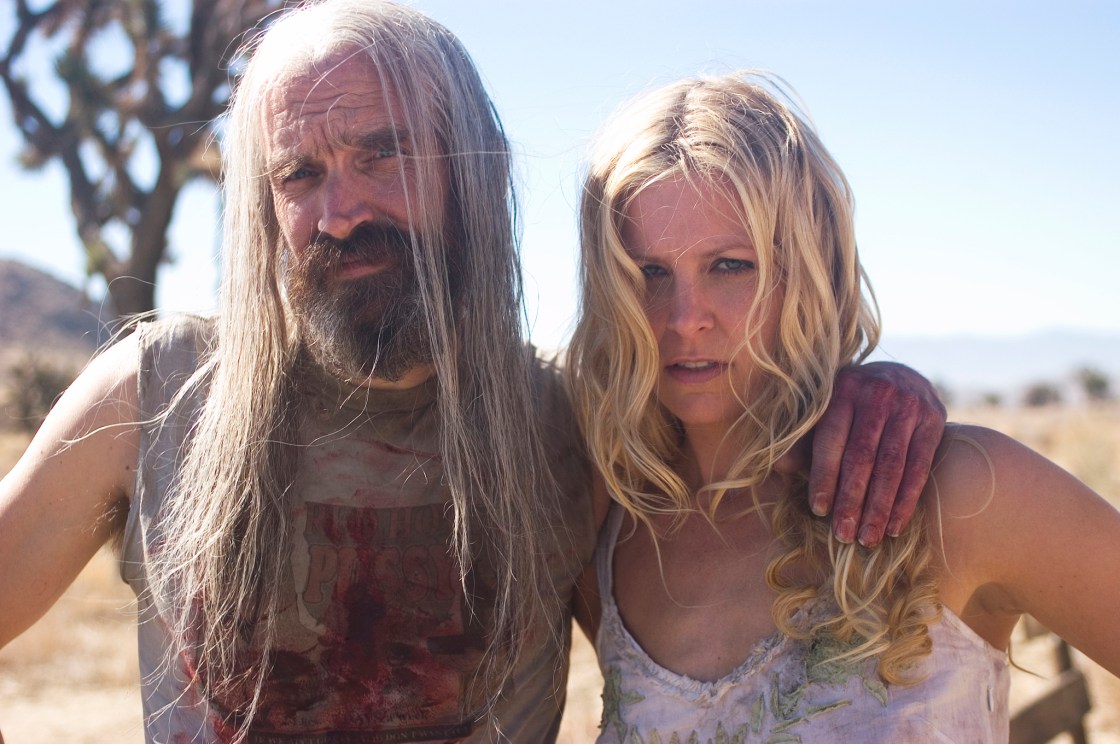
If you’ve been around No But Listen since the early days, you’ll know that I am, for my sins, a fan of Rob Zombie’s work.
Which comes with the most ridiculously enormous set of disclaimers you can imagine. Because, yes, while I grew up on these films, and they went a long way into defining my taste in horror both of the past and the future, Rob Zombie does churn out A Lot of Shite. Aside from flabby dialogue, dodgy casting, and overlong sequences, there’s always someone getting stabbed through the bare tit, and there’s only so much of that I can take, you know?
But with that said – when I realized that we were approaching the twenty-year anniversary of the middle part of his Firefly Family trilogy, The Devil’s Rejects, I knew I had to write something about it. Because I still have such a soft spot for this movie in my heart – and, despite its issues, I still think it’s one of the most impressive in Zombie’s back catalogue.
It didn’t take long for The Devil’s Rejects to earn near-legendary status as a psuedo-video-nasty – along with its predecessor, House of 1000 Corpses, Zombie had already made a name for himself in the world of gore, splatter, and gross-out shlock. The Devil’s Rejects picks up right where the first movie leaves off, with the central trio Baby (Sheri-Moon Zombie) and Otis (Bill Moseley), join forces with Captain Spaulding (Sid Haig) to escape the police and continue their roughshod run of mayhem and murder.
And, look, if you’re here for the splatter and the gore, you’re not going to be let down. Rejects is exceptionally, gleefully violent in creative and occasionally jaw-dropping ways – a slasher movie-cum-road-trip, it delivers in terms of intensity and consistency of violence from our leads. But, also, and perhaps more interestingly, from the cops pursuing them – in Zombie’s vision of this world, there are basically only perpetrators and victims, and the cops fall very much into the perpetrator side of things.
But beyond the gore, what’s made The Devil’s Rejects such an enduring favourite for me is the scattered moments of pure, cinematic brilliance that Zombie brings to the screen. Horror was not exactly seen as a high-art genre at the time these movies were being released, at least by the mainstream, and, as a result, his films were painted with a broad brushstroke of schlock – which isn’t an entirely unfair way to define them, but still, I think it obscures some genuinely impressive scenes that prove Zombie’s passion for the genre goes past just imitation. Perhaps the most well-known example is the closing sequence, featuring a shootout and the best use of Free Bird in cinema (fight me), a soaring and almost moving close to the film and these characters, at least as they exist in Rejects. But my personal favourite is Bill Moseley’s sensational Devil’s Work speech – the dialogue, the cinematography, this vision of Otis towering down against the sun, you’d really believe him when you called himself the devil.
And, to this day, twenty years later – I don’t think I’ve ever seen a movie quite like The Devil’s Rejects. It’s a slasher road trip that’s also mostly family bickering the back of a vehicle; a mess of genre influences, director homages, with a sprinkle of Zombie’s own distinct and occasionally brilliant style. While the long-awaited sequel, 3 From Hell, had its pluses and minuses, The Devil’s Rejects remains, for me, the best part of the trilogy – and perhaps even the best movie in Zombie’s back catalogue.
The Devil’s Rejects is a pretty divisive movie, and I’m really interested to hear your takes on it below – let me know in the comments what you think of this film, either at the time of its release or years later! If you enjoyed this article and want to see more stuff like it, please consider supporting us on Ko-Fi. You can check out more of my work on my personal blog, The Cutprice Guignol!
By Lou MacGregor
(header image via IMDB)
 No But Listen