Here at No But Listen, we’ve been banging on about Yorgos Lanthimos pretty much since day one.
And with good reason – the Greek director’s back catalogue is a uniquely weird blend of drama, horror, comedy, and bizarre tonal lurches between the three. I really love his movies, from the almost fairy-tale tone of Dogtooth to the witty sex drama of The Favourite, and Poor Things was always high on my list of movies to see this year. Adapted from an Alaisdar Gray novel of the same name, Poor Things stars Emma Stone as Bella Baxter, a woman navigating life after a mad scientist Godwin (Willem Defoe) transplants the brain of her own baby into her body.
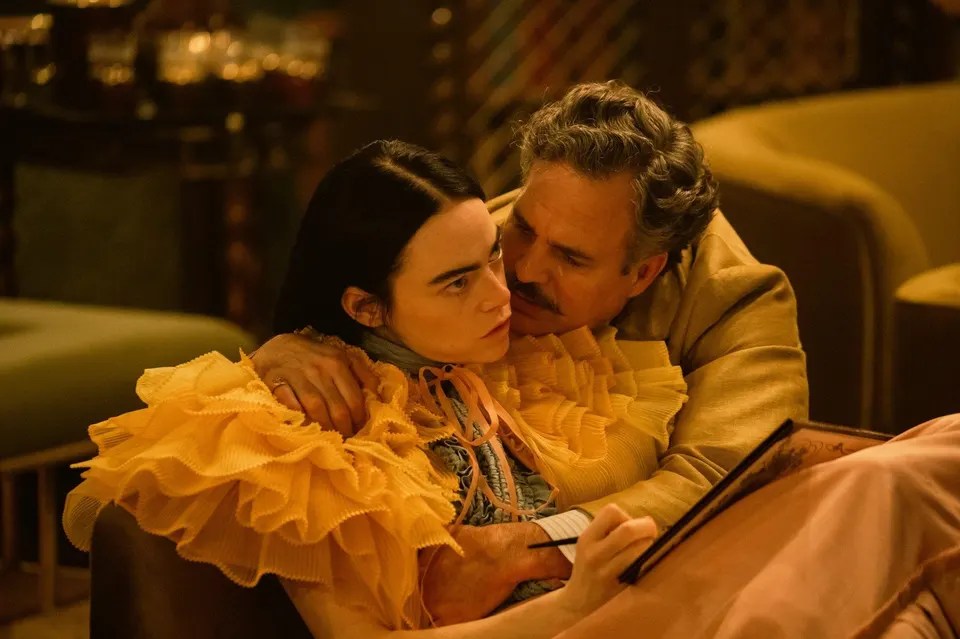
And yes, that’s a batshit premise, and I’d expect no less of a Yorgos Lanthimos film. With the success of The Favourite, it’s clear he’s had more room to indulge his very specific cinematic style, and God, what a treat it is to see it in full force here. Poor Things, in terms of production design, has to be one of the most sumptuously handsome films I’ve ever seen, every detail in every frame serving to add to this story and these characters. From the costumery to the hairstyles to the set dressing, this is a damn food orgy for the eyes, straddling fantasy and reality with ease and confidence.
But, beyond that, what about the story? Well, I actually love what Poor Things does with these characters – for about the first hour and a half, at least. Poor Things casts a critical eye over heterosexual romantic and sexual dynamics, as Bella embodies the grotesque logical endpoint of the Born Sexy Yesterday trope. Her childishness and uncivilized behaviour serve as an enchanting, even alluring trait to the male characters she encounters, an uncomfortably recognizable experience for most women, and Poor Things doesn’t shy away from how foul and twisted these desires aimed at Bella are. She’s a baby in the body of an attractive woman, a literal version of the same character that’s inhabited film for decades now. Emma Stone’s performance is tremendous, especially in the early section of the film – utterly childlike despite her physical maturity.
When Duncan (Mark Ruffalo, brilliant now he’s finally been liberated from the Sad Dad roles once more), a self-proclaimed rogue with a trail of broken-hearted lovers behind him, begins a sexual relationship with Bella, it begins to fall apart. Her once-charming disrespect for social mores is embarrassing, even threatening to his sexual prowess – she’s alluring as long as the standards she ignores are the same as the ones he does, and when they diverge, he’s shattered by it. It’s such a strong arc for the movie, about control and sex and the fetishization of the “wild” woman, and right up until this point, I was loving it.
But where the movie really begins to struggle for me is in when Bella arrives in Paris and begins working at a brothel. Now, sex work is a contentious topic at the best of times, but I think it’s one that makes a lot of sense to be included in a movie like Poor Things, which has so much to say about the power allocated to women’s sexuality, whether they’re in control of it or not. I don’t have an issue with the character getting into sex work, or the depiction of sex work in general, but I felt like Lanthimos really missed an opportunity to better interrogate the themes of his film with this part of his story.
Given how arch and sharp Poor Things is in its exploration of the way men use, judge, and consume women’s sexuality, to take the most literal version of it here and water down the conversation around it to barely a scene of arguing amongst workers (led by Kathryn Hunter, who truly is one of the most astonishingly brilliant actors to grace the stage with her presence, and her Richard the III needs to be studied) that they should be able to choose clients but can’t – it’s not enough for me, not enough for this conflict to be hand-waved away with a few socialist catchphrases.
It’s such a significant part of the already-long movie and really slows down the plot to focus on what are, functionally, a collection of scenes of Emma Stone having lots and lots of sex for money and generally enjoying the whole thing without much criticism. The more compelling questions remain unanswered in any meaningful way: why do these women do this work? Do they want to do it? What choices do they have if they don’t? How do the experiences of the other sex workers differ from Bella’s specific intersection of privileges (especially strange to skip over, given the impact the class system is shown to have on her earlier in the film)?
Not to say that sex workers in real life can’t or shouldn’t enjoy their work, but in this story, to provide such little context and emotional texture as to the men using these services or the women providing them, their motivations, their decisions, and their freedom to do so, felt like a gaping hole to me (and anyone sniggering at the back will be cuffed around the ear, by the way).
And, after that sequence, the film sort of trudges to a conclusion that’s as beautiful as ever, though marginally less compelling than the first couple of acts. Poor Things starts so strongly with the deconstruction and gleefully sharp critique of cinematic tropes around women, youth, and the fetishization of childishness and inexperience, but it drags into the third act as Bella discovers who she once was before and lays claim to a new life for herself. It should be satisfying to see her take control, after everything we’ve seen her go through, but there are a few pieces missing here to string everything together and make her narrative feel whole. It’s still a good film, even a great one, in many ways, but Poor Things struggles to stick the landing with some of the film’s central tenets left unsatisfyingly unexplored.
I would love to hear what you thought of Poor Things – I know it’s been a divisive film, and I’m interested to know how other people found the handling of these themes and ideas. Let me know in the comments!
If you enjoyed this article and want to see more stuff like it, please consider supporting us on Ko-Fi. You can check out more of my work on my personal blog, The Cutprice Guignol!
By Lou MacGregor
(header image via Forbes)
 No But Listen