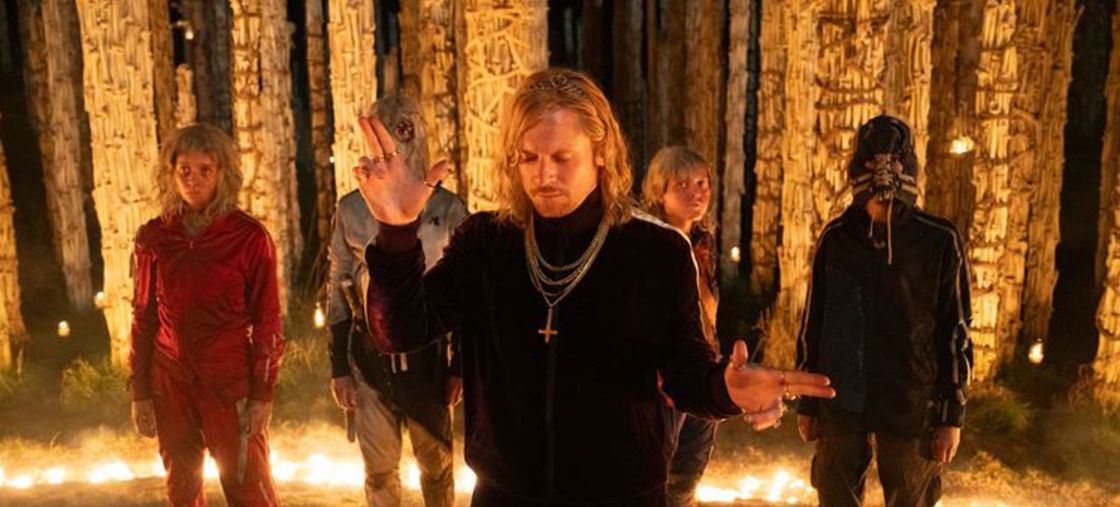
The Bone Temple might just be one of the outright weirdest movies I’ve seen hit the mainstream in decades.
And I mean that entirely as a compliment. After the supremely accomplished set-up of 28 Years Later, Nia DaCosta takes the reins (with Alex Garland returning for writing duty) for the second part of the cinematic zombie trilogy – a great pick for a director when it comes to potentially tricky follow-ups, as her impressive Candyman sequel proves. But, where the last film took on a powerful and polished coming-of-age story, The Bone Temple dives into matters of belief, faith, and humanity, told through the lens of a Teletubbies-obsessed cult leader dressed like Jimmy Saville and a man acapella-ing Duran Duran under his breath while he drags about dead bodies. Yeah, I know, but let’s get into it, shall we?
The movie picks up where the last left off as Spike (Alfie Williams) is inducted into Jimmy Crystal’s (Jack O’Connell) small satanic cult of serial killers and general denizens of the devil – only to find themselves at the titular bone temple, as created by Ian (Ralph Fiennes), a doctor who is navigating life post-apocalypse as he finds purpose in uncovering the humanity in a frequent zombie visitor. Fundamentally, while Williams is the main holdover from the last movie, it’s a film about Ian and Jimmy, and the various approaches they take to their iterations of faith and humanity in a world that has seemingly lost so much of its order and meaning.
And these sorts of characters – the ones who represent Good and Bad in the narrative, at least in broad terms – can so often fall into the trap of preachiness or downright boredom, but these performances are career-bests for both actors, and that’s really saying something. O’Connell’s here might be the best of his entire career, a truly blood-curdling mix of absolutely absurdity and unfathomable brutality draped in the veil of satanism that lands him at the top of his self-made hierarchy. It’s a genuinely hilarious turn at times, and then it hits you with a dose of gore so hideous you’ll be reaching for the nearest platinum blonde wig to vomit into. It’s beyond weird and beyond brilliant, a testament to his performance and DaCosta’s skilled framing of him that it doesn’t descend into parody.
And then there’s Fiennes, at the centre of the bone temple itself, a testament to life and loss alike. His frequent interactions with a powerful zombie he’s nicknamed Samson (Chi Lewis-Parry) serve as his emotional arc in this film, as he attempts to uncover the creature’s humanity and discover if and how the virus can be treated. There’s a beautiful marriage in his character between the pragmatism of science and medicine and optimism for a better future; the logical so often falls in line with the pessimistic in cinema that this feels genuinely fresh. The relationship between him and Samson is one of my favourite parts of this movie, the achingly brief flashes of Samson’s humanity embodied so brilliantly by Lewis-Parry that you feel it just as much as Ian does.
The film climaxes with the two coming together, as Jimmy’s cult (all brilliant, but featuring particularly excellent performances from Erin Kellyman and Emma Laird as a doubter and a discipline, respectively) identifies Ian as the devil himself and come to him for counsel. It’s here that the film’s themes really come together, that notion of faith as a cover for what humanity is capable of, both good and bad. For Ian, that faith has been in science and medicine and the possibility of a cure, underneath the ossuary of bones that serves as a memorial to the lost – for Jimmy and his cult, it’s a call to unthinkable violence and cruelty, worship taking the form of suffering and abuse. Now that we’ve had the coming-of-age story of Spike’s ascent to manhood (or the version of it that exists in this new world), we have to figure out what a life here looks like, what it’s dedicated to, and how the urge to find meaning and faith can shape it
And it all unfolds via a lip-sync to Iron Maiden’s The Number of the Beast. And it works. Somehow, despite or perhaps because of its oddness, it all comes together in a way that I could not possibly have fathomed it would be able to. It’s a completely bizarre movie, by any measure, with that weirdness distilled into the two main characters, but it creates the backdrop for a fascinating voyage through the meaning and magnitude of belief. If the final part of this trilogy sticks the landing, 28 Years Later will be an all-timer for the books – but even if it doesn’t, The Bone Temple was worth the ride alone.
If you enjoyed this article and want to see more stuff like it, please consider supporting us on Ko-Fi. You can check out more of my work on my personal blog, The Cutprice Guignol!
By Lou MacGregor
(header image via Odeon)
 No But Listen