For years, it was the tease that was never paid off. When we last left the rage virus, at the end of 28 Weeks Later, it had migrated to Paris, with enough ravenously furious infected running at the Eiffel Tower that you might believe it was responsible for the Stranger Things finale. Years went by and… nothing. Danny Boyle and Alex Garland seemed to constantly tease a third film while one was busy winning Oscars and creating Olympic opening ceremonies, and the other decided to give directing a try resulting in films seemingly designed to piss people off. Now, all of a sudden we are getting a brand-new trilogy – and if the first instalment is anything to go by, it could solidify the franchise into full classic status.
28 years later, the rage virus has been limited to Great Britain. No one can get off the island and, according to a doomed soldier halfway through the film, if you enter the quarantine zone, you are basically fucked. He is, as Boyle goes out of his way to remind us, very right about that. This is a world that, even after all this time, is still in a transitional stage. In order to survive, the human race has gone backwards – Boyle and Garland pepper the script with references to the old days, B-roll of classic British battles and warfare scattered amongst the contemporary setting.
Spike (a revelatory Alfie Williams) is our avatar in this transition, a twelve-year-old boy who comes of age through very different walks outside his isolated island community. The first walk is with his father (Aaron Taylor-Johnson expertly getting the stink of Kraven the Hunter off of him for good), in which he completes a test of masculinity and maturity by killing one of the infected. It’s about seeing the world outside, the barbarism, the rot of once populated places – about facing death and not being afraid. It is also about the uneasy bond between a father and son, the balance of a father’s protection and his need for the son to really see the world as it is and prove his masculinity in terms his father can celebrate. If this sequence was the full film, I would call it a classic but somehow Boyle and Garland level up with Spike’s second walk.
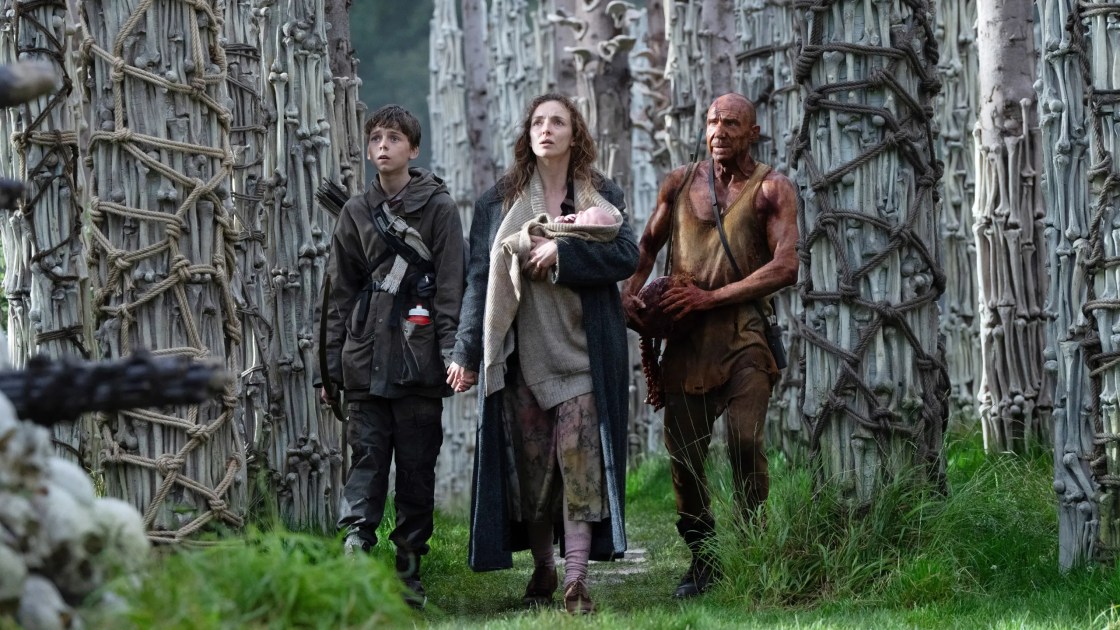
In this walk, the emboldened and desperate Spike takes his terminally-ill mother (Jodie Comer, who is so good it’s just the norm for her now) to Doctor Kelson (a demented-looking but incredibly warm Ralph Fiennes) – who, while he’s unable to treat his mother, shows Spike a different perspective of death. Through his Bone Temple, he celebrates the life and memory of the dead instead of treating the dead as an aberrance to be separated from the living both literally and metaphorically.
If 28 Years Later has one overriding theme (it’s got tons, but bear with me) it is memory. Through each generation, it is memory that is the delicate thread that connects this world to the one before some eco-terrorists freed the wrong test animals. It is these memories that haunt Spike’s father, it is his mother’s illness that throws her from the present to comforting memories of her grandfather, and it is the Bone Temple itself that serves as a symbol to all of what has been lost but not forgotten.
This is a head-fuck for poor Spike, but that is the point. He is the child of a new world and he has to grow up a hell of a lot quicker because of it. Boyle and Garland have rejected the temptation for full-scale mayhem to craft a story that is quieter and more introspective, though there is plenty blood and guts flying for the gorehounds. It feels more akin to Jim’s transformation into a man of action and brutality in the first film. Spike isn’t quite their yet but he has just run into a bunch of tracksuited acrobats led by a man called Jimmy; who isn’t supposed to remind you of any real life scumbag at all. Seriously, though, how the fuck did Boyle and Garland think of that?
With Nia DaCosta taking the reins for the next part of the trilogy, I’m fascinated to see where this story goes next – but, even if this film remains the highest point of this story, it’s an extraordinary addition to the canon and one that cements this series into movie history anew.
If you enjoyed this and want to see more stuff like it, please consider supporting us on Ko-Fi.
By Kevin Boyle
(header image via British GQ)
 No But Listen