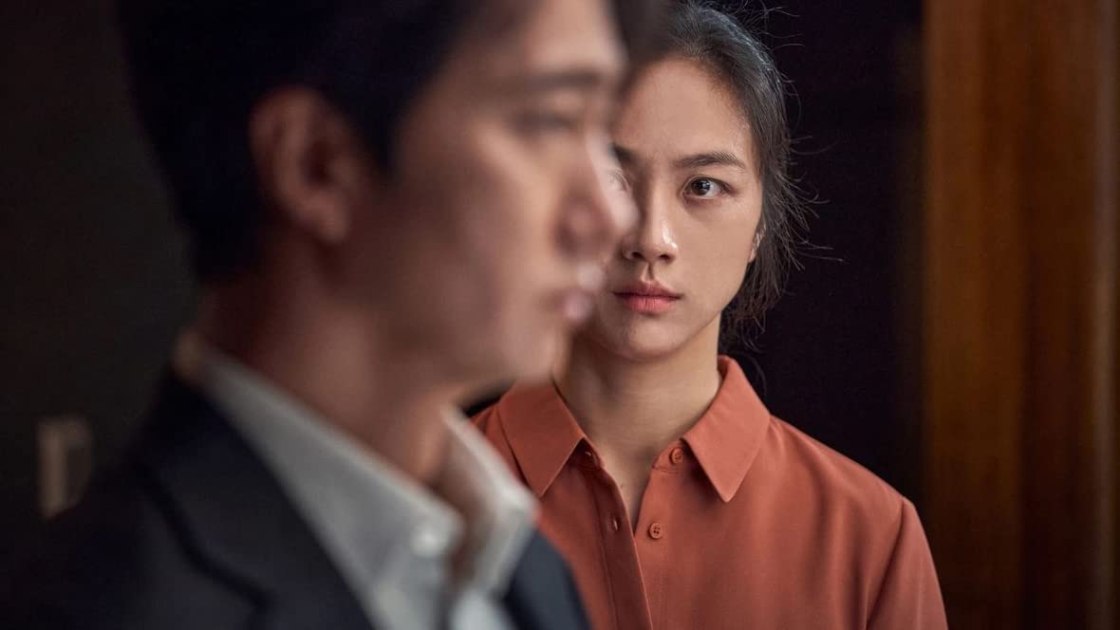
Well, what with it being my birthday month and all, I figured that I was due a little indulgence here on No But Listen (as though I doing anything but indulge, but you know what I mean). And that indulgence, this weekend, comes in the form of Decision to Leave.
I’ve been watching – and loving – Park Chan-wook’s movies for years now, from his legendary revenge thriller Oldboy to his sensual vampire horror Thirst to his offbeat sci-fi drama I’m a Cyborg But That’s Okay. Chan-wook has such a distinct style, a blend of black humour, polished cinematography, and bleak subject matter often matched with amazing action to boot, and, as he spans styles and stories with ease, it’s been so exciting to see how his signature style will apply to his latest genre excursion.
Which brings me to 2022’s Decision to Leave. Now, there are plenty of movies you could point to as Chan-wook’s best, and I’d be hard-pressed to argue with you; when we’re talking about a director working at such a high level, there’s an embarrassment of riches to choose from when it comes to the best-of. But, for me, Decision to Leave is the pinnacle of Chan-wook’s career (so far, at least) because of how it combines the highest points of his previous work and distils them into one almost unfathomably polished whole.
Following Jang Hae-jun (Park Hae-il), a detective who finds himself investigating the strange death of a one-time immigrations officer with a much younger Chinese immigrant wife Song Seo-rae (Tang Wei), Decision to Leave revolves around Hae-jun’s entanglement with the mysterious and potentially murderous Seo-rae. On paper, it’s slippery to define under a single genre – there’s romance here, thriller, mystery, drama, procedural, even moments of taut action. But Chan-wook’s experience across the gamut of cinematic styles means that every stylistic elements is polished to near-perfection, with each story element strong enough and confident enough to carry a movie in its own right.
I mean, take the central relationship between Seo-rae and Hae-jun; there’s little more than a kiss here on-screen, but the chemistry is searing from practically the first moment they appear on screen together. Chan-wook plays with denial and obsession, the characters finding ways to get close to each other without breaking the rules (either marital or legal) in the process. There’s a sequence of the two of them just breathing together that’s more sensual and erotic than the entirety of Fifty Shades of Grey, and I’m not even close to exaggerating. A rich interpersonal drama about closeness and distance matches the recurring images of the tides and the sea that dot the movie, as Hae-jun navigates an obsession with a potential suspect and the growing space in his increasingly-strained marriage.
Then there’s this brilliant mystery at the heart of the movie, one that at first seems obvious, but, over the course of the story, becomes muddied by the viewer’s relationship with the characters in question. Chan-wook lays out the answers early on and spends much of the rest of the film trying to cast doubt on them, leaving the audience as much caught up in the deception as any of the characters are. It’s not an action-heavy film per se, but the brief glimpses we get of it are propulsive and breathless, a reminder of why he’s one of the directors to beat when it comes to the genre, even when the film doesn’t necessarily call for it.
Decision to Leave, for me, is the finest of Chan-wook’s career so far because it’s proof of not just his skills across almost any genre you can think of, but his mastery of them too. I would love to hear your take on his filmography, and where DTL stands amongst them for you – let me know in the comments!
If you enjoyed this article and want to see more stuff like it, please consider supporting us on Ko-Fi. You can check out more of my work on my personal blog, The Cutprice Guignol!
By Lou MacGregor
(header image via IMDB)
 No But Listen