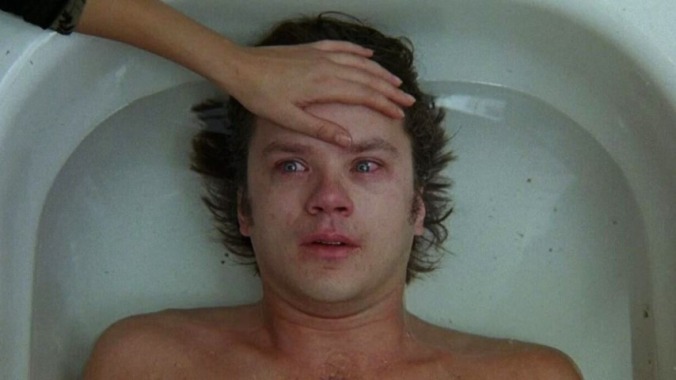
When it comes to movies of the 1990s, it’s hard to think of many that have had the impact of Jacob’s Ladder.
Adrian Lyne’s psychological horror follows the titular Jacob (Tim Robbins), a Vietnam war veteran living in New York after his return from conflict who is plagued by nightmarish and demonic visions. Not that I probably need to tell you that, given that the movie has influenced dozens of iconic pieces of horror media since its release – from The X-Files to Silent Hill, Lyne’s marriage of reality and the grotesque is, even thirty-five years later, a uniquely and intimately discomforting experience.
Jacob’s Ladder is at its most effective, for my money, in the first act or so, which focuses on what appears to be Jacob’s PTSD as he tries to resettle into normal life after the war. The way Tim Robbins plays Jacob in these early scenes is the definition of a raw nerve, the agony so close to the surface that he can’t even begin to contain it, try as he might to do so. His trauma forces its way into his life via visual and auditory hallucinations, insisting on making itself known even in moments of comfort or intimacy. He takes a monotonous job just to avoid having to think – in the brief moments he reconnects with his fellow soldiers, that wellspring of pain and trauma boils to the surface only to be crushed down once more as Jacob tries to live his life. It’s a profoundly impactful piece of storytelling in that regard, and one that imbues the audience with that heavy sense of unease and dissociation that so often characterizes the disorder. The flashes of horrific images against the backdrop of everyday life are, arguably, the most recognizable visuals of the movie, and there’s a reason that they stick in the mind as long as they do, you know?
But, ultimately, it’s not what the movie is about. I think Jacob’s Ladder as a whole is a relatively simple movie when you take it as a full piece – a purgatorial journey that follows Jacob through the process of letting go of his old life and moving into the afterlife, as told through a relatively Christian lens due to Jacob’s upbringing and experiences. It’s become a bit of a trope in the years since (partly because of this very movie), but that’s not a bad thing – the “entire-lifetime-lived-while-dying” leaves a lot of space for abstract images and themes to be unravelled, and Jacob’s Ladder, like so many of the stories it’s influenced, rewards multiple watches to piece it all together. Done well, as it is here, this “none of it was real!” story doesn’t feel like a rug-pull but like an effective character study, where the narrative is wrapped up in absolution rather than specific action.
But, with any story that serves as the popular template for a trope, Jacob’s Ladder leaves a little to be desired. The closing moments of the film that seem to indicate that the whole thing was little more than a reaction to an experimental drug used by the US army on its own soldiers, which, to me, is far less interesting than contending with the senseless brutality and violence of the war and how it traumatized Jacob and the others he fought alongside; on top of that, the movie does very much frame Jacob and his compatriots as victims in this conflict, when the USA’s involvement in Vietnam is far, far more complicated than that.
Jacob’s Ladder is an undeniably iconic part of the cinematic canon of psychological horror – an effective and uneasy deconstruction of a character that’s served as the tidemark by which others in the genre are based (the less said about that remake, though, the better). With Jacob’s Latter being such an emotive movie that’s open to interpretation, I would love to hear your analysis or feelings on it in the comments below – let’s climb that ladder together! Or, uh, something a little less sinister.
If you enjoyed this article and want to see more stuff like it, please consider supporting us on Ko-Fi. You can check out more of my work on my personal blog, The Cutprice Guignol!
By Lou MacGregor
(header image via Paste)
 No But Listen