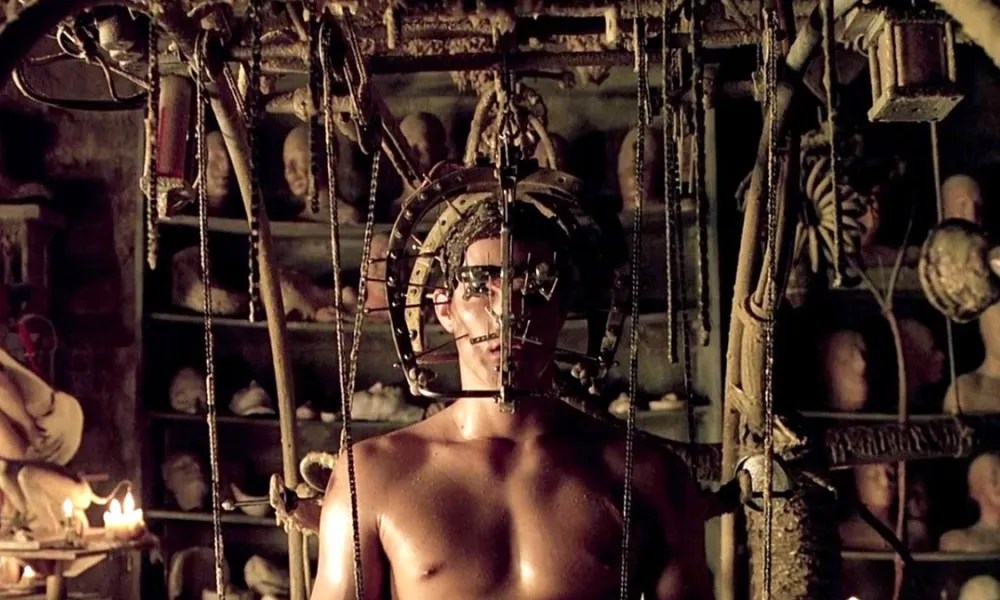
In some ways, House of Wax is a bit of a strange entry into the world of 2000s remakes.
Not just because it had Paris Hilton in it (though we’ll get to that), or because it happened to revolve around a collection of teens getting turned into a tourist trap worthy of Madame Tussauds. But because the majority of the movies and characters earning reboots at this time were long-standing and well-liked IPs such as Nightmare on Elm Street, Halloween, or Friday the 13th, but director Jaume Collet-Serra picked a 1953 Vincent Price movie (itself a remake of the 1933 original Mystery of the Wax Museum) that had been mostly used to market a failed attempt at 3D horror cinema. It’s an exceptionally specific choice, and one that bucked the rehashing of 70s and 80s slashers in favour of something a little more goofy and a whole lot weirder by comparison.
And God knows that, before it even came out, House of Wax was caught up in a whole lot of weird, uncomfortable, and outright dangerous nonsense. If you remember this movie when it released, as I do, you’ll have been lucky to avoid the Watch Paris Die marketing – Paris Hilton, who fills out the ensemble as Carly’s best friend (and, along with Repo! The Genetic Opera, her respectable career as a mid-noughties scream queen), was practically public enemy number one pop culturally at this point, and her feature in this movie was publicized with a thigh-rubbing campaign anticipating the thrill of getting to watch her get violently murdered onscreen (which she does in a set of matching red lingerie, because, of course). A serious fire on-set led to the production company behind the movie, Wax Productions, getting sued for several million by one of the movie’s own distributors, Village Roadshow Studios, and early critic reviews dismissed the film as a weak, predictable, and ultimately forgettable entry into teen slasher flick territory.
But, twenty years later, where does this weird remake fit in the 2000s horror scene? In a lot of ways, it’s a perfect example of so many of the aspects (good and bad) that haunted this era of horror – the pop-metal soundtrack, the cardboard cutout supporting cast, the rural, small-town setting that seems designed to give you as many bad sets of teeth to cringe at as possible. The kills are gory, gruesome, and gleeful, Jared Padelecki is there; you can almost tick this off as you go, right?
But, at the same time, what has made House of Wax a bit of a standout against the other movies in this genre is the way that it subverts a few expectations and delivers on a truly unique and memorable setting. The bizarre nature of the choice to remake a lesser-known 1953 movie, I think, speaks to the obvious passion Collet-Serra has for this story – and, for a director as confident behind the camera as he is, Collet-Serra really lends this movie a rich atmosphere that might be its biggest selling point. The actual town of Ambrose where the majority of the story takes place has this echoing, almost cavernous emptiness to it that begins to reveal itself as the true nature of the crimes that have taken place unfold, the sense of being trapped in a specific time and place lending it a distinct ghost town vibe. The action setpieces that make up the final act, the house melting out beneath the surviving cast as they try to escape, are genuinely just really cool – with so many slashers climaxing in a fight between the final girl and the killer, House of Wax has a sense of scale to it that I really appreciate.
The central relationship of the story, too, makes for an interesting change – Carly (Elisha Cuthbert, who still hasn’t bettered her brilliant performance in Happy Endings, as far as I’m concerned) is the film’s main focus, and at first it seems like her romance with Wade (Padalecki) is the natural centrepoint of the movie – only for Wade to buy it in the most gruesome fashion imaginable, and leave Nick (Chad Michael Murray) as Carly’s only source of help. Their strained but profoundly deep sibling relationship serves a different dynamic to the usually standard-issue romantic plots that sit in the middle of these films. Murray and Cuthbert have a really believable, lived-in chemistry, with Murray especially channelling every bit of bad-boy early 2000s smoulder into an exceptionally watchable lead.
And, of course, Carly and Nick serve as a parallel for our killers, too – Brian Van Holt plays both Bo and Vincent Sinclair, the heirs to the wax attractions who also happened to be unthinkably violent serial killers. House of Wax has its (wax) cake and eats it too with these villains; Vincent fills out the archetype of the force of nature, the mostly-silent stalk-and-slash villain in the vein of Jason or Michael, while Bo gives us the smart-talking, charismatic, and charming gentleman killer.
I think House of Wax, two decades after it came out, has been unfairly consigned to the trashcan of horror remakes that came out during this era. With some cynical marketing and unfortunate hallmarks of the genre, it’s not as though it hasn’t somewhat earned that. But, beyond that, House of Wax is a unique and surprisingly atmospheric little slasher that has long outlasted its origins. With that said, I’d love to know what you think of House of Wax – either now or at the time it came out – so let me know in the comments below!
If you enjoyed this article and want to see more stuff like it, please consider supporting us on Ko-Fi. You can check out more of my work on my personal blog, The Cutprice Guignol!
By Lou MacGregor
(header image via Bloody Disgusting)
 No But Listen