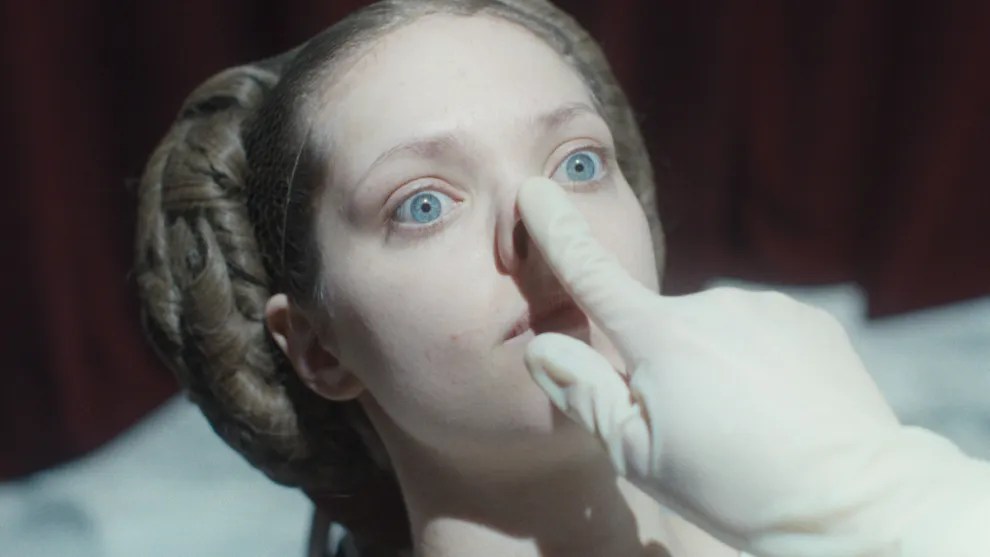
The Ugly Stepsister is a film that you could define in a million different ways. A retelling of Cinderella, a female-focused body horror in the vein of The Substance, an extraordinary debut for Emilie Blichfeldt that puts on full display of her command of distinct visuals, pitch-black comedy, and stomach-churning horror all at once – a phenomenal breakthrough for Lea Myren, who stars as Elvira, the titular ugly stepsister intent on doing whatever it takes to win the love of her adored prince.
For me, at its core, The Ugly Stepsister is a movie about the contradictions of the things that we ask women to place value in. It’s a tapeworm egg nestled in pink paper in a beautiful locket, it’s Elvira’s fantasies of being swept into the arms of her prince for a chaste kiss versus the misogynist objectification the prince exhibits in real life, it’s a needle stabbing through the delicate skin of the eyelid to stitch fluttering new lashes into flesh. But one of the contradictions I found most compelling was that of hunger and beauty, and how the two are intrinsically interlinked in such a twisted way in the world that Blichfeldt creates.
Early in the movie, one of the issues that is underlined in Elvira’s appearance is her weight – Elvira is shown to eat sweets and pastries when she’s under particular emotional stress, sometimes even emotional stress caused by criticism of her weight when she can’t fit into a dress. She is distinctly aware of her body in these moments, the camera lingering on the rolls in her stomach, the shape of her breasts – though her body is utterly normal, literally and figuratively, does not fit into the standards set for her.
So, Elvira does what any sensible young debutante would do: she swallows a tapeworm egg, assuring her sister that she will take the antidote just as soon as she is thin and beautiful. Blichfeldt goes out of her way to make the scene as gross as possible, the little worm wriggling inside the translucent egg before she gulps it down.
From that moment on, hunger is a constant drumbeat in the background of The Ugly Stepsister – often literally, as the soundtrack is constantly punctuated by the sound of a grumbling stomach – it’s an undercurrent of starvation, occasionally managed with binges, that drives her closer and closer to her final goal: of achieving the prince’s love. Even as she attends the ball, adorned in flowers and wigs to cover for her hair falling out in clumps due to malnutrition, she starves, her stomach growling in the confines of her perfect dress. Her hunger is a constant reminder of not just what she lacks in terms of food and nutrition, what she must lack in order to pursue this standard of beauty.
And, of course, when she is unable to acquire the prince’s adoration, she goes to some pretty extreme measures to try and win it back. In one of the film’s more brutal sequences (and trust me when I say that there are plenty – on the train home after seeing this movie, a stranger asked me with great concern if I was alright, and I can’t blame them), she hacks off her toes with the help of her mother to try and fit into the iconic slipper the prince is using to track down is ideal bride.
Of course, it fails – and, in one of the movie’s final scenes, she finally expels the tapeworms. Yes, plural. It was probably the most visceral moment of the movie for me – her sister, yanking this wriggling creature from her throat, only for Elvira to then vomit up a slithering grey pile of tapeworms who have taken residence in her guts. It’s an utterly, memorably grotesque sequence, and one that succinctly underlines the movie’s central tenant: the aberrant truth of beauty, and the ugliness women must inflict on themselves to acquire it. It’s no coincidence that the tapeworms are the last thing to go in terms of Elvira’s pursuit of ideal beauty and the ideal life she believes will follow it.
The Ugly Stepsister is an extraordinary film in so many ways, but Blichfelft’s gruesome commitment to the contradictions inherent in feminine standards of beauty is perhaps my favourite part. If you’ve seen the film, I’d love to hear your take on these aspects or on the movie at large – let’s talk in the comments!
If you enjoyed this article and want to see more stuff like it, please consider supporting us on Ko-Fi. You can check out more of my work on my personal blog, The Cutprice Guignol!
By Lou MacGregor
(header image via The Wrap)
 No But Listen