Where is Alfred Hitchcock’s second movie?
It’s a question that has plagued film historians and Hitchcock completionists alike for the better part of a hundred years now, but one that we still don’t have an answer to. Let’s get into The Mountain Eagle – and whether we’re ever likely to see Hitchcock’s elusive sophomore feature.
The Mountain Eagle was Alfred Hitchcock’s follow-up to his silent first feature, The Pleasure Garden; The Pleasure Garden, released in 1926, was a collaboration between Emelka Film Studios (now Bavaria Film) in Germany and Gainsborough Pictures. After a positive reaction to initial screenings of the movie, Hitchcock was offered a chance to shoot in Germany and Austria to shoot his follow-up feature, The Mountain Eagle (despite the fact the movie was set in Kentucky), with the support of Emelka, in 1925.
At first, it seemed like this new location would offer Hitchcock a chance to build on his developing style; shooting in studios in Munich, he was able to tap into the more experimental cinematography of German expressionism. The story, following a bitterly widowed man competing with his disabled son for the affections of a local schoolteacher, served as one of the first explorations of the recurring theme of a man on the run, and the cast, including iconic cinematic vamp Nita Naldi and Bernhard Goetzke who played Death in the iconic Fritz Lang Destiny trilogy, brought some cinematic clout to their roles.
But it didn’t take long for problems to arise. Location shooting took place in Obergurgl, Austria, after Hitchcock had spotted a postcard that he thought vaguely resembled the swooping valleys of Kentucky. After a gruelling journey Hitchcock and the rest of the crew clashed with the locals over the course of their three-month shoot. When they arrived, a snow had settled over the landscape, which Hitchcock ordered the local fire department to blast away with their hoses – leading to the collapse of the roof of a building nearby. The mayor was forced to step in to demand compensation, which Hitchcock gave in the form of two shillings, but his issues with the town were only just beginning.
Shooting had to be put on hold for several days as Hitchcock dealt with severe bouts of nausea, vomiting, and altitude sickness – though Hitchcock himself, who had already offended locals by refusing to stay at a local inn, put his sickness down to the guttural sound of the local accent. By the time the shoot was complete, Hitchcock was glad to see the back of the place (and, no doubt, the guttural locals felt the same way).
The stress of the shoot seemed to take its toll on the quality of the finished article as, when it was screened for British distributors in 1926, they declined to release it, leaving it to gather dust. That was, until the surprise success of Hitchcock’s third movie, The Lodger, the year after – hoping to capitalize on the box office draw of the film, The Mountain Eagle was swiftly rolled out a mere three months after the release of The Lodger, hitting cinemas in May 1927. The film, which received a limited release in the UK, across some parts of Europe, and in America, is recorded as having played till the end of 1929.
The film, however, didn’t reach the heady heights of The Lodger, and received a lukewarm critical response – critics generally appreciated Hitchcock’s eye for cinematography and artistic lighting, but were let down by the lack of realism in the story and the characters.
And those reviews are about the only thing we have to go on about the quality of the movie – because it hasn’t been seen since its original release. At the time it was made, movie preservation was virtually unheard of, with audiences more interested in contemporary releases that old pictures; the nitrate stock upon which the film were shot also suffered from swift deterioration, leading to the loss of many movies due to a combination of a lack of interest and physical neglect. For nearly a hundred years, the film has remained lost, leaving a significant gap in Hitchcock’s filmography (even though it’s one he seemingly wasn’t too bothered about – in conversation with François Truffaut years later, he described it as “very bad”, criticizing the studio’s insistence on Naldi’s casting as a schoolteacher).
While The Mountain Eagle seems to have most likely been lost to time, searches continue for Hitchcock’s sophomore feature. In the late 90s, the British Film Institute announced their renewed attempts to find the movie, suggesting that because “the film was made in Europe there is the possibility that an enthusiast in one of the old Eastern bloc countries, who were not allowed to collect films under the Communist regime, might have a copy under another name”.
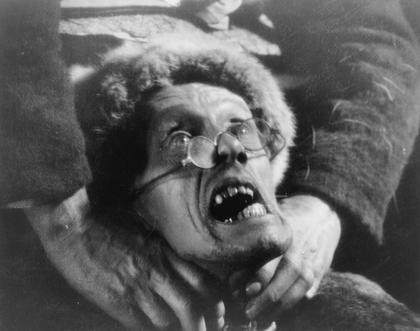
Over the years, some tantalizing glimpses have been uncovered- stills of Hitchcock on location with his then-fiancee Alma Reville (who wrote the film) were discovered in the late 2000s, and six stills from the film and production have been shared by the BFI from their Stills, Posters, and Studies collection. These small snippets, while they don’t fill out much of the movie, capture a unique and intriguing look into Hitchcock’s early work, with dramatic shadows, sinister lurking figures, and the sweeping Austrian landscape filling out the frame.
While the actual discovery of this movie doesn’t seem likely, I sincerely hope there’s a copy still hiding out in a dusty old film collection somewhere. Do you think a copy of The Mountain Eagle is ever going to turn up, or is it lost to time? Let me know in the comments below!
If you enjoyed this article and want to see more stuff like it, please consider supporting us on Ko-Fi. You can check out more of my work on my personal blog, The Cutprice Guignol!
By Lou MacGregor
(header image via BFI)
 No But Listen