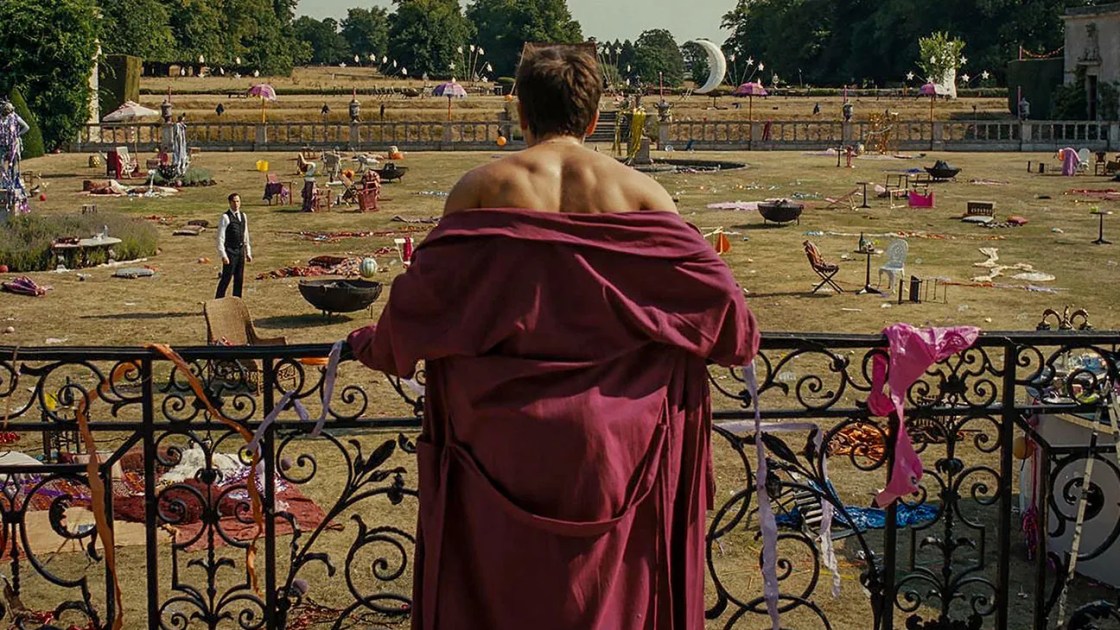
There is no escape from Saltburn.
Not just within the movie, but out of here in the real world, too. Or at least, that’s how it feels – Emerald Fennel’s sophomore feature, a follow-up to her lauded debut Promising Young Woman, is one of those zeitgeist movies that is waiting to jump out at you around every cinematic corner you turn. Whether people love it, hate it, are disgusted by it, are bored by it, it’s a strange little movie that broke containment and became a huge talking point as a result – for better or worse.
Following Oliver (Barry Keoghan), a working-class student attending the prestigious Oxford University, Saltburn tracks his friendship with Felix (Jacob Elordi), a young man from a wealthy family who Oliver begins to ingratiate himself with over the course of one summer at his family home of Saltburn.
And let’s cut right to the chase here: Saltburn has a lot of good stuff in it. A lot of great stuff, even. The highlight, for me, is the performances – Barry Keoghan’s stratospheric rise into the pantheon of great British character actors continues here, but the supporting cast easily match him. Rosamund Pike is a blackly-comic delight, and Alison Oliver’s debut feature film performance as Felix’ sister Venetia might have been the highlight of the whole piece.
Emerald Fennel’s direction, too, is an absoloute treat; she creates a real sense of otherworldliness in Saltburn, capturing the decadence of the upper classes alongside the barren space that resides between the members of this family. She shoots Jacob Elordi like an old-school ingenue, commanding cinematic language to show us just how Oliver feels about him, and the film has an uneasy, fantastical quality that’s an excellent addition to her skill as a director.
But, for me, Saltburn doesn’t quite trust its audience enough. I loved the movie up until the last fifteen minutes or so, when a flash-forward epilogue serves to explain Oliver’s true motivations and actions throughout the film; it really feels like a lot of this is tagged on out of fear that people might not understand the story being told here. Oliver’s final villain monologue feels particularly out-of-place for the restraint in his character thus far, a last-minute piece of insurance that everyone walks out if the cinema Getting It. Fennell did a solid job with her arch, tight script in telling us the story beneath the one we thought we were seeing, and I wish Saltburn had been confident enough to trust that we could put it together – given how complex a lot of the characters and relationships are, and how much they’re left up to the audience’s interpretation, it seems strange for the movie to take such a different approach with the plot.
Saltburn is also a movie now renowned for its oddness, which, for the most part, I quite liked – the scenes that have earned a shocking reputation, such as, and I’ll just say it, the cum-slurping, generally serve the plot as opposed to just serving to discomfort the audience. On the other hand. the now-iconic closing sequence, of Oliver dancing naked through the house to Murder on the Dancefloor, felt self-conscious in its deliberate incongruence to me, a shocking moment crafted in a lab to garner as many TikTok shares as possible (and one that goes on far too long for my liking, too).
It’s certainly not a bad film, and I wouldn’t want anyone coming away from this review thinking I believed it was – I know with how divisive the movie has been, big opinions on either side of the aisle tend to be what sticks. But Saltburn flubs it in the finale, with a closing act that doesn’t trust the audience to piece together the breadcrumbs Fennell and the cast did such a good job sprinkling throughout this story.
If you enjoyed this article and want to see more stuff like it, please consider supporting us on Ko-Fi. You can check out more of my work on my personal blog, The Cutprice Guignol!
By Lou MacGregor
(header image via Swim Press)
 No But Listen