I, once again, yet again, must assure you that I am not going out of my way to have unpopular movie opinions.
When I saw that the new Insidious movie, The Red Door, had sub-thirty-percent on Rotten Tomatos, with the critical consensus a sort of knowing shake of the head at the state of a franchise five movies deep, I was ready for it to suck. I was! I have a soft spot for the Insidious movies, as they were the major blockbuster horror breakthrough around the time I was really getting into the genre, but that doesn’t blind me to a bad movie – thirteen years after the original came out, and with a couple of dodgy sequels in the bag, it wasn’t as though I couldn’t admit that this was a bad film, if it happened to be.
The directorial debut of it’s star, Patrick Wilson, The Red Door follows Dalton (Ty Simpkins), the child star of the original movie, as he heads off to college and the dark memories that have been repressed from his past begin to sneak up on him again. As he navigates a strained relationship with his partially-estranged father (Wilson), the family’s buried history comes to light as cracks begin to show in the façade.
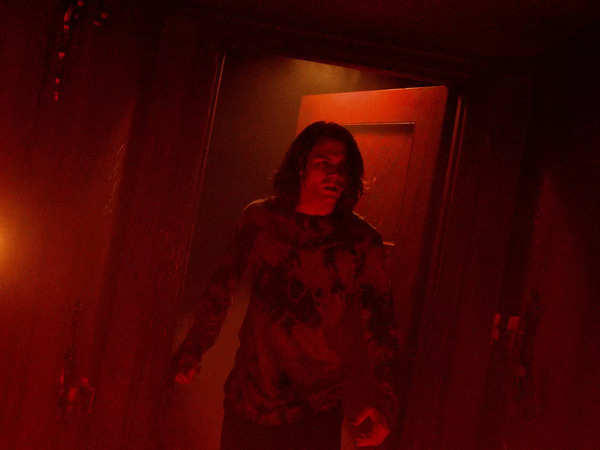
And look, listen, look at me – this is a perfectly good horror film. Downright great at times, actually! I think it fits really well into the current horror landscape, which is so focused on trauma, especially of the familial kind – the fractured relationship between Dalton and his father genuinely has some weight thanks to the very solid performances and obvious history between Simpkins and Wilson, and I genuinely enjoy the metaphor of this repressed paranormal encounters standing in for the dark corners of familial history that rot a clan from the inside out. It’s an interesting take on the story, and, with more than a decade since the first Insidious film came out, even on a meta-level, this narrative works in terms of the sheer distance between this film and that one.
I don’t think Patrick Wilson blows it out of the park on his first try or anything, but there are some great scares here – reserved, slow-builds that actually worked to create a genuinely unsettling atmosphere. Especially in the first hour or so of the movie, as the ghosts start to needle their way into Dalton’s reality, Wilson’s experience in the genre serves him well. There are a few Filmmaking 101 shots that are typical in movies by actors jumping behind the camera for the first time, but they’re not invasive. Insidious has a distinct visual style in terms of the Further, and I love seeing that come to life again – even though we only really get glimpses of it in it’s full glory, it’s simple, striking colour palette makes for a world that feels off in a suitably disturbing way.
And, really, this movie is a chance for Ty Simpkins to prove himself as something other than a child actor – if The Red Door is anything to go by, I’m looking forward to seeing what he does next. Sinclair Daniel is a major helping hand here, as her character Chris helps lift Simpkins out of too much brooding young adult angst; it’s hard to get the Gen Z humour right without having it come off as utterly irritating to anyone over the age of twenty-five, but her sparky delivery and entertaining presence had me giggling when she used the term “mening-jay-jay” for meningitis.
It’s not just that The Red Door isn’t as bad as people are saying it is – it’s actually downright rather good. I’m honestly kind of baffled by the negative reviews and dour critical reaction, but I truly think it’s worth a watch, especially if you’re a fan of the original pair of Insidious movies. It makes for an interesting end to a functional trilogy about the Lambert family, and hey, Leigh Whannel turns up for five minutes in a YouTube video – what more could you want?
If you enjoyed this article and want to see more stuff like it, please consider supporting us on Ko-Fi. You can check out more of my work on my personal blog, The Cutprice Guignol!
By Lou MacGregor
(header image via The Economic Times)
 No But Listen
Reblogged this on The Cutprice Guignol.
LikeLike